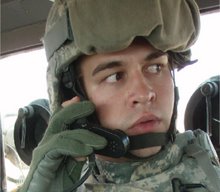
Several days ago we were on another mission out through the farmland surrounding Falluja. It's the middle of the night, and my truck is out in front again, swapping places periodically with the mine sweeping truck. The road is ugly- it's narrow, muddy, sloped slightly towards the deep canal on the right, and elevated between six and ten feet above the field to the left. It's the kind of road that would make you nervous to drive on at home, and here there are people trying to blast you off of it into the canal. It makes me very nervous.
Usually, I tend to avoid thinking about things that make me nervous. There's too many of them. That night, however, I started to compile a list in my mind. It's quite a list, and as anyone who has been to Iraq or even seen a few pictures knows, the items on the list are everywhere.
Potholes.
Blast holes.
Man holes.
Cut-out holes.
Concrete patches in holes.
Dug up and/or disturbed earth.
Broken concrete.
Bumps in the road.
Geometric arrangements of rocks, sticks, or scrap.
Dirt roads.
Canal roads.
Paved roads.
Narrow roads.
Elevated roads.
Muddy roads.
Moving traffic.
Stopped traffic.
Twisted hulks of vehicles.
Abandoned vehicles.
Especially fuel tankers.
Absence of people.
Wires.
Cables.
Strings that look like either.
Cassette tape.
Tall reeds.
Undergrowth.
Pipes.
Culverts.
Ditches.
There's a sampling. I'll edit later with more entries and some pictures.
Sunday, February 25, 2007


Thursday, February 22, 2007
Badger 6: Badgers Down
Badger 6 has written here about the events that cost the lives of three of my friends, three members of my platoon, and three of his soldiers. He has other posts as well, telling about who they were as more than names and faces. Go there if you want to learn. Don't mistake anything you read about them there as hyperbole- the CO is giving you the straight story. He knew these men, too. I doubt I'll write more about them for a while.
Milbloggies: Milblog Contest
Ok. The nominating that you did over this last week for Milbloggies was the preliminary heat. Now, the top five blogs in each category will compete for the next two days in final voting.
Acute Politics finished the nomination phase solidly in the top position in both Iraq Milblogs and Army Milblogs. If you can spare the time and frustration, go back and brave the servers at www.milblogging.com and cast your final votes among the nominees for the top blog in each category. The voting starts today.
Acute Politics finished the nomination phase solidly in the top position in both Iraq Milblogs and Army Milblogs. If you can spare the time and frustration, go back and brave the servers at www.milblogging.com and cast your final votes among the nominees for the top blog in each category. The voting starts today.
Monday, February 19, 2007
Faces in the Crowds
Every time I get into a conversation about Iraq with someone back home, they ask me what the kids are like, or what the people are like, or what the women do. Normally, the only time I see given to the Iraqi people in the news is for the numbers of the dead, and the rantings of radical Muslims. I can look around me as I go on patrol and see faces everywhere that belong to neither group.
There are the middle-aged men in black robes and red headdresses who glare at us as we pass. They squat in circles and whisper to each other, and strike their children when they wave and call to us. I rarely see women among them.
There was the young Iraqi girl in an orange headdress that blew a kiss at me as we passed her at a checkpoint. She got embarrassed and hid her face when I smiled back.
Once, as we returned to Ramadi from Falluja, I saw an Iraqi man driving his truck through the rain. There were four women in traditional garb in the back of the truck, huddled together for warmth. On the front seat next to the man was his dog.
In one small village near the canals in Falluja was one of the cutest kids I've ever seen. She was only four or five, and looked like my sister did at that age- curly dark hair around her round, dimpled face. She smiled big and waved, asking for candy- I spread my hands and told her I didn't have any. She covered her eyes and started pouting, and then turned again to smiles within seconds. As we drove out of sight I could see she was still waving.
There was the old man out working his field- I saw him leaning up against his shovel watching us leave underneath the setting sun. He was old enough to have known life before Saddam as well as after. I can't help but wonder what he thinks of us.
Everywhere, there are children. If the streets are free of children, we start to look for the imminent attack. They love to have their picture taken, and all of them know that American troops are endless wells of candy. These kids are the future of Iraq. If they grow up to hate, I have little hope that there will ever be peace on this place.
There are the middle-aged men in black robes and red headdresses who glare at us as we pass. They squat in circles and whisper to each other, and strike their children when they wave and call to us. I rarely see women among them.
There was the young Iraqi girl in an orange headdress that blew a kiss at me as we passed her at a checkpoint. She got embarrassed and hid her face when I smiled back.
Once, as we returned to Ramadi from Falluja, I saw an Iraqi man driving his truck through the rain. There were four women in traditional garb in the back of the truck, huddled together for warmth. On the front seat next to the man was his dog.
In one small village near the canals in Falluja was one of the cutest kids I've ever seen. She was only four or five, and looked like my sister did at that age- curly dark hair around her round, dimpled face. She smiled big and waved, asking for candy- I spread my hands and told her I didn't have any. She covered her eyes and started pouting, and then turned again to smiles within seconds. As we drove out of sight I could see she was still waving.
There was the old man out working his field- I saw him leaning up against his shovel watching us leave underneath the setting sun. He was old enough to have known life before Saddam as well as after. I can't help but wonder what he thinks of us.
Everywhere, there are children. If the streets are free of children, we start to look for the imminent attack. They love to have their picture taken, and all of them know that American troops are endless wells of candy. These kids are the future of Iraq. If they grow up to hate, I have little hope that there will ever be peace on this place.
Sunday, February 18, 2007
Random Tidbits
New Readers:
I've been getting a lot of new visitors over the last few days. If this is your first time here at Acute Politics, I'd like to encourage you to browse through the archives. You can find some favorites of mine, and of my regular readers here, here, here, here, and here. Enjoy!
Good Humor:
I don't know who thought it would be a good idea to give thirty bored soldiers super-strength mouse catching glue (the humorous translation from Arabic on the tube is "Magic Power Adhesive") and a box of mousetraps, but it happened. NEWS FLASH: FUNNY, BUT BAD IDEA!
Dumbass of the Week:
Rep. Carolyn McCarthy (D-NY) calls for stricter gun control laws to "prevent further violence", such as the mass murder/suicide this last week in Philadelphia. She manages to believe that the gunman carried a "legally purchased AK-47", rather than two handguns, as the police said. Strike one. She says "The deaths in Philadelphia could have been prevented if Congress had done its job of protecting the homeland and renewed the assault weapons ban", apparently failing to realize that said ban failed to ban either handguns or AK-47s. Strike two. Since strikes one and two weren't enough for one day, she continues by saying "I remain committed to passing common sense legislation to prevent further acts of gun violence", referring (among other laws) to the AWB. Right. Common sense to airheads and fan clubs for symbolic yet useless legislation. Unless any of you have heard of recent drive-by bayoneting cases, or shootings in which the gunman used more than ten rounds AND didn't have time to change a mag, I will maintain that the restrictions of the AWB on weapon functionality amount to functionally worthless legislation.
Sorry, Ms. McCarthy. That's three strikes. Hopefully New York has the sense to put you out.
Pending Move:
Blogger continues to frustrate me with authentication problems and lack of features such as integrated traffic statistics. I'm in the process of migrating this blog over to a Wordpress account. I'll be keeping Acute Politics mainly short stories and some prose, but I'll also be posting more poetry on a separate account I am in the process of setting up. Hopefully, that will cater to both the readers who want to read poetry, and those who could just as easily live without. I'll also probably post more poems than I otherwise would.
I've been getting a lot of new visitors over the last few days. If this is your first time here at Acute Politics, I'd like to encourage you to browse through the archives. You can find some favorites of mine, and of my regular readers here, here, here, here, and here. Enjoy!
Good Humor:
I don't know who thought it would be a good idea to give thirty bored soldiers super-strength mouse catching glue (the humorous translation from Arabic on the tube is "Magic Power Adhesive") and a box of mousetraps, but it happened. NEWS FLASH: FUNNY, BUT BAD IDEA!
Dumbass of the Week:
Rep. Carolyn McCarthy (D-NY) calls for stricter gun control laws to "prevent further violence", such as the mass murder/suicide this last week in Philadelphia. She manages to believe that the gunman carried a "legally purchased AK-47", rather than two handguns, as the police said. Strike one. She says "The deaths in Philadelphia could have been prevented if Congress had done its job of protecting the homeland and renewed the assault weapons ban", apparently failing to realize that said ban failed to ban either handguns or AK-47s. Strike two. Since strikes one and two weren't enough for one day, she continues by saying "I remain committed to passing common sense legislation to prevent further acts of gun violence", referring (among other laws) to the AWB. Right. Common sense to airheads and fan clubs for symbolic yet useless legislation. Unless any of you have heard of recent drive-by bayoneting cases, or shootings in which the gunman used more than ten rounds AND didn't have time to change a mag, I will maintain that the restrictions of the AWB on weapon functionality amount to functionally worthless legislation.
Sorry, Ms. McCarthy. That's three strikes. Hopefully New York has the sense to put you out.
Pending Move:
Blogger continues to frustrate me with authentication problems and lack of features such as integrated traffic statistics. I'm in the process of migrating this blog over to a Wordpress account. I'll be keeping Acute Politics mainly short stories and some prose, but I'll also be posting more poetry on a separate account I am in the process of setting up. Hopefully, that will cater to both the readers who want to read poetry, and those who could just as easily live without. I'll also probably post more poems than I otherwise would.
Saturday, February 17, 2007
How Human Are We?
It's time for another one of those posts. Yep, the kind of post that gets nutjobs at places like Vanity Fair all up in a tizzy. Maybe I'm pushing too far with this one- I'm writing about something that I feel many of you can never understand.
I left the billets early tonight for the mission. I racked my machine gun in the cradle, and sat on top of the truck. I plugged in my iPod, took a sip of coffee, and sat back to watch the sunset. Somehow, the setting sun always seems to look better here than at home; the sunsets are the one beautiful thing about this place. I watch as the dying sun slowly sinks, its rays falling across sand, mud, guard towers, satellite dishes, and all the other things that have come to mean home for a time. The sky is brilliant with golds and crimsons- here and there a tendril of flame licks up a wisp of cloud.
Some say the world will end in fire/Some say in ice/From what I've tasted of desire/I hold with those who favor fire
The sun has set, and Venus shines low in the sky in poor reflection. The others are starting to straggle out to the vehicles. It's time to prep for the mission. Tonight, we're going back up into the general area where we lost three of ours so shortly ago- not the same road- and this is the first time we've been back that way. I look around at my friends and try to read their faces. They could be scared, and most of us are, a little. They could be numb- just doing their job. Again, most of us are, a little. However, I think that most of us are out for blood. It might sound horrible, inhuman, even medieval, but the fact of the matter is that someone out there killed friends of ours, and we're going back into a place where we just might get the guy that did it. We'll never know if it was him, of course, but there's always the chance that we'll even the scales unknowingly.
Killing is not natural to sane people, no matter how often it has happened over eons. There are many ways that you can reconcile yourself in some way to the idea of killing another human. You can think of it as duty- you have a job, and that job requires violence. You can hate- the easiest of all excuses, and the most exhausting. You can look at it as simple survival- if you don't kill him, then he'll kill you. However you justify it, you are still in a war, and people will still die. It wears on everyone- the American deaths, the "collateral damage" we inflict on people in the wrong place at the wrong time, the innocents killed when some faceless murderer blows himself up in a crowd. Yes, even the enemy dead take their toll.
The headphones sing-
If I ever leave this world alive/I'll come back down and sit beside your feet tonight/Wherever I am you'll always be/More than just a memory/If I ever leave this world alive
One more mission.
One more chance to find a bomb.
One more chance to save a life.
One more chance to take one.
One more chance to die.
I left the billets early tonight for the mission. I racked my machine gun in the cradle, and sat on top of the truck. I plugged in my iPod, took a sip of coffee, and sat back to watch the sunset. Somehow, the setting sun always seems to look better here than at home; the sunsets are the one beautiful thing about this place. I watch as the dying sun slowly sinks, its rays falling across sand, mud, guard towers, satellite dishes, and all the other things that have come to mean home for a time. The sky is brilliant with golds and crimsons- here and there a tendril of flame licks up a wisp of cloud.
Some say the world will end in fire/Some say in ice/From what I've tasted of desire/I hold with those who favor fire
The sun has set, and Venus shines low in the sky in poor reflection. The others are starting to straggle out to the vehicles. It's time to prep for the mission. Tonight, we're going back up into the general area where we lost three of ours so shortly ago- not the same road- and this is the first time we've been back that way. I look around at my friends and try to read their faces. They could be scared, and most of us are, a little. They could be numb- just doing their job. Again, most of us are, a little. However, I think that most of us are out for blood. It might sound horrible, inhuman, even medieval, but the fact of the matter is that someone out there killed friends of ours, and we're going back into a place where we just might get the guy that did it. We'll never know if it was him, of course, but there's always the chance that we'll even the scales unknowingly.
Killing is not natural to sane people, no matter how often it has happened over eons. There are many ways that you can reconcile yourself in some way to the idea of killing another human. You can think of it as duty- you have a job, and that job requires violence. You can hate- the easiest of all excuses, and the most exhausting. You can look at it as simple survival- if you don't kill him, then he'll kill you. However you justify it, you are still in a war, and people will still die. It wears on everyone- the American deaths, the "collateral damage" we inflict on people in the wrong place at the wrong time, the innocents killed when some faceless murderer blows himself up in a crowd. Yes, even the enemy dead take their toll.
The headphones sing-
If I ever leave this world alive/I'll come back down and sit beside your feet tonight/Wherever I am you'll always be/More than just a memory/If I ever leave this world alive
One more mission.
One more chance to find a bomb.
One more chance to save a life.
One more chance to take one.
One more chance to die.
Thursday, February 15, 2007
Slacker
I'm going to be taking it slow for a few days on the blog. I know, I know... some of you would remark that me taking it slow is nothing unusual. Don't worry, though- I'll be back in a few days with some new posts and perhaps one about the memorial that we had Tuesday.
In the meantime, go to www.milblogging.com, register for an account, and nominate Badger 6 and/or myself in the 2006 MilBlogs contest. The nominations run through 22 Feb, at which point the top 5 blogs in each category (Service Branch and Country) will move on to voting for another four days.
In the meantime, go to www.milblogging.com, register for an account, and nominate Badger 6 and/or myself in the 2006 MilBlogs contest. The nominations run through 22 Feb, at which point the top 5 blogs in each category (Service Branch and Country) will move on to voting for another four days.
Monday, February 12, 2007
The Road To Hell
The DOD has officially announced the deaths of our guys. This is the post I mentioned earlier: written on the 8th and held until the brief came out.
I reported this morning for guard duty at 1115. The sergeant of the guard told us that someone had been hurt in Falluja, and taken to the Falluja Surgical Center. Falluja. My thoughts ran wild: is it my guys, or another platoon? Who was in front today? Who was it? Right before we leave for the towers, the sergeant comes back outside and tells us that the wounded man didn't make it. I know the name- shit- it's my guys. The tip of my cigarette is glowing, but it doesn't seem to ash. Time is supposed to slow down when you're in the moment, not when you're hearing of it.
The next four hours are glacial- slower and colder than I could have thought. The 1st Sergeant comes out to the tower to update us: It's not just one guy, it's three, and another in bad shape. The news is like a punch in the stomach.The lead truck took a hit from a massive bomb. Two of my friends died instantaneously. A third passed away on the helicopter flight back to the base medical center, and a fourth man lies badly wounded but stable at the FSC.
The guard shift change comes with directions to go find the 1st SGT again- something has changed. I make my way to the company operations center, and find the entire staff and the few members of my platoon who stayed behind gathered around the big screen that shows the positions of vehicles on the ground. Another truck has taken a hit, and they've medevaced another wounded soldier by helicopter.
I learn that the mission they were on was clearing the route to the site of an American helicopter that crashed the day before. The previous night they had cleared a path out so that the bodies of the crew could be recovered. Today, they had gone back to clear a path home for the Marines left to guard the airframe until arrangements could be made for its recovery and/or destruction. After the the first truck had been hit, they had pressed on to reach the Marines at the crash site, only to turn back when the second truck was hit. A Marine route clearance unit is diverted to the site, and eventually clears through. Meanwhile, we all sit and watch the screen track our platoons slow and painful progress back towards safety. I take my leave again, and go with a few friends. We sit, and begin to speak of the dead.
One of the dead men had been a friend of mine as long as I'd been in the unit. We'd laughed together, drank together, and talked about the future. He'd got me started smoking at NTC at the same time that he was trying to quit. Tonight, I'm helping organize the things he left behind. His girlfriend of a year meets me at his room to give me another box. She's from another company; they met just prior to our deployment alert, and have struggled to build their relationship through the midst of war. She looks smaller than I've ever seen her, as if she's lost a physical part of herself.
Under a sky streaked blood-red and angry with sunset, I carry my friends belongings from his room. In my head I can already see another sun setting over the memorial to come; the breeze twisting dogtags around a rifle like a devils windchime, and carrying once again the plaintive notes of the bagpipe playing Amazing Grace.
Rest in peace
SGT Holtom
SGT Clevenger
PFC Werner
I reported this morning for guard duty at 1115. The sergeant of the guard told us that someone had been hurt in Falluja, and taken to the Falluja Surgical Center. Falluja. My thoughts ran wild: is it my guys, or another platoon? Who was in front today? Who was it? Right before we leave for the towers, the sergeant comes back outside and tells us that the wounded man didn't make it. I know the name- shit- it's my guys. The tip of my cigarette is glowing, but it doesn't seem to ash. Time is supposed to slow down when you're in the moment, not when you're hearing of it.
The next four hours are glacial- slower and colder than I could have thought. The 1st Sergeant comes out to the tower to update us: It's not just one guy, it's three, and another in bad shape. The news is like a punch in the stomach.The lead truck took a hit from a massive bomb. Two of my friends died instantaneously. A third passed away on the helicopter flight back to the base medical center, and a fourth man lies badly wounded but stable at the FSC.
The guard shift change comes with directions to go find the 1st SGT again- something has changed. I make my way to the company operations center, and find the entire staff and the few members of my platoon who stayed behind gathered around the big screen that shows the positions of vehicles on the ground. Another truck has taken a hit, and they've medevaced another wounded soldier by helicopter.
I learn that the mission they were on was clearing the route to the site of an American helicopter that crashed the day before. The previous night they had cleared a path out so that the bodies of the crew could be recovered. Today, they had gone back to clear a path home for the Marines left to guard the airframe until arrangements could be made for its recovery and/or destruction. After the the first truck had been hit, they had pressed on to reach the Marines at the crash site, only to turn back when the second truck was hit. A Marine route clearance unit is diverted to the site, and eventually clears through. Meanwhile, we all sit and watch the screen track our platoons slow and painful progress back towards safety. I take my leave again, and go with a few friends. We sit, and begin to speak of the dead.
One of the dead men had been a friend of mine as long as I'd been in the unit. We'd laughed together, drank together, and talked about the future. He'd got me started smoking at NTC at the same time that he was trying to quit. Tonight, I'm helping organize the things he left behind. His girlfriend of a year meets me at his room to give me another box. She's from another company; they met just prior to our deployment alert, and have struggled to build their relationship through the midst of war. She looks smaller than I've ever seen her, as if she's lost a physical part of herself.
Under a sky streaked blood-red and angry with sunset, I carry my friends belongings from his room. In my head I can already see another sun setting over the memorial to come; the breeze twisting dogtags around a rifle like a devils windchime, and carrying once again the plaintive notes of the bagpipe playing Amazing Grace.
Rest in peace
SGT Holtom
SGT Clevenger
PFC Werner
Sunday, February 11, 2007
Heads Up:
As many of you have no doubt heard, we lost three soldiers just a few days ago. There was something of a slip up somewhere in the process, and the facts of the incident were released before the official DOD brief (but after the families had heard, thank God). All three were from my platoon, and I was pretty good friends with two of them. It's been a rough week, especially on the tail of losing one from another company. I have a post written that I'm hanging onto until that DOD brief comes out, and I'll post more as I'm able.
Edit: Once again, I've been convinced to post a poem. I hope I never write another like the last two.
Halls of Valhalla
Four days ago, they left
From safely guarded walls
Three taken now by theft
Four days, and yet it seems
Fate made three captive thralls
To laugh within our dreams
Four days, and now they dwell
Within Valhalla's Halls
Maidens, treat our fallen well
Show them not the road to Hell;
Rather gird the path with beams
Hide them deep inside a cleft
And Valkyries- heed their calls
Edit: Once again, I've been convinced to post a poem. I hope I never write another like the last two.
Halls of Valhalla
Four days ago, they left
From safely guarded walls
Three taken now by theft
Four days, and yet it seems
Fate made three captive thralls
To laugh within our dreams
Four days, and now they dwell
Within Valhalla's Halls
Maidens, treat our fallen well
Show them not the road to Hell;
Rather gird the path with beams
Hide them deep inside a cleft
And Valkyries- heed their calls
Friday, February 09, 2007
Amazing Grace
The haunting wail of bagpipes is drifting over our corner of Camp Ramadi. Bravo company's amateur pipist is slowly pacing while he practices a song none of us want to hear. The tune he plays is Amazing Grace. Tomorrow morning he will play it at the memorial service for CPL Shannon, the first member of our task force to die here in Iraq. He fell to an unlucky hit from one of the improvised bombs that litter the roads. He was from another company- one of the few from that group that I've spoken with. I didn't know him well, but I'm proud to say I knew him. I wrote a poem in his memory that I didn't plan to post, but one of his friends asked me to.
See now, the soldier-
So far away from home
He's staring into night
And wishing it would end
See now, the bomber-
Fighting war for Allah
He's laying in the grime
Waiting by the trigger
See now, the splinter-
Chased by fiery lace
It's flying with the blast
And tearing flesh in flight
See now, the father-
A bomb-hole in his heart
He's weeping for his son
So far away from war
Rest in peace, Steve.
Note:
This post was written 6 days ago. I held it for a few days out of concern for the soldier's family. It took me a few more days after that to publish because of various concerns these last few days.
~TD
See now, the soldier-
So far away from home
He's staring into night
And wishing it would end
See now, the bomber-
Fighting war for Allah
He's laying in the grime
Waiting by the trigger
See now, the splinter-
Chased by fiery lace
It's flying with the blast
And tearing flesh in flight
See now, the father-
A bomb-hole in his heart
He's weeping for his son
So far away from war
Rest in peace, Steve.
Note:
This post was written 6 days ago. I held it for a few days out of concern for the soldier's family. It took me a few more days after that to publish because of various concerns these last few days.
~TD
PSA:
The Military Channel is looking for video taken by military personell deployed overseas. As their representative wrote to me:
Mailing Address
MILITARY VIDEOS
8045 Kennett Street
Silver Spring, MD 20910
If you're interested, you can send video clips to www.mywardiary.com, or the address below. You can also email mywardiary@discovery.com for more information, or check the DOD Brief." Real-life moments captured on film by service members will be broadcast
on the Military Channel as part of a new on-air programming initiative.
Servicemen and women anywhere in the world who brought a camcorder with
them on a recent deployment, or those who currently have a camera with them on
the frontlines, can submit their videos directly to the Military Channel. "
Mailing Address
MILITARY VIDEOS
8045 Kennett Street
Silver Spring, MD 20910
Monday, February 05, 2007
*Sigh*
I'm starting to miss my internet. I'm stranded away from my platoon this week, doing the guard duty that all of us get stuck with at some point. I'm continuing to write on my personal computer, but it's difficult to get online, and often harder still to connect to Blogger. Basically, in my own long and rambling way, I'm excusing myself from consistent posting for a week or so. We'll see what happens.
Also, as readers of Badgers Forward know, I got my promotion to Specialist several days ago. That was a nice bright spot in the week for me, as I've been waiting for it for a long time. Add that to the Combat Action Badge I was awarded not too long ago, and my uniform is starting to get heavy. Don't worry- I'll try not to fall in any canals.
Also, as readers of Badgers Forward know, I got my promotion to Specialist several days ago. That was a nice bright spot in the week for me, as I've been waiting for it for a long time. Add that to the Combat Action Badge I was awarded not too long ago, and my uniform is starting to get heavy. Don't worry- I'll try not to fall in any canals.
Saturday, January 27, 2007
QPQ II
If you've been following this blog long, you may remember Quid Pro Quo. That was the post in which I told of a brave sheik, and one of the sucess stories of our interaction here in the Anbar province. I would like to refer you to the LA Times, where you will find more detail than I provided, and an account of events since. You're required to register for the site, but it is free to do so and definitely worth the time.
Contest Update:
The VA Mortgage Center blog contest is over.
Acute Politics ended up in 7th place. I will be donating the $250 prize to Project Valour-IT.
Thanks to all of you who voted.
Acute Politics ended up in 7th place. I will be donating the $250 prize to Project Valour-IT.
Thanks to all of you who voted.
Iraqi Gourmet
The food here is the best I've had in the military to date. I don't know how much that really says about it, but it's not too bad. The chow hall is a basic buffet line- a hot food line as you come in the door, an island with salad and other things that food eats, another station with sandwich materials, pasta, and some variety of other hot courses, and a desert bar.
The main line has a rotating menu selection. Sunday is steak and seafood, and I don't care enough about the other offerings to pin down what days they appear. I'm usually bored by the first line anyway. Sandwiches are great to make and take along to eat later on mission (which is against the rules, but who's counting?). The rest of the menu on the auxiliary station is what interests me. Occasionally, it's "picnic food" such as mac&cheese, hot dogs, or other such boring offerings, but usually it's ethnic food of one sort or another. Picky eating was bred out of me long ago, and it's at this station I usually head in search of something good to eat.
A few days ago, I started with a breakfast of Indian Sheikh Kebab- small seasoned sausages with grilled onions and tomatoes, wrapped in naan flatbread. For lunch I had parts of an MRE because we were out on mission and I forgot a sandwich (Okay, so that was a major low point). Dinner was French Beef Provencale, pork and shrimp stuffed pepper, and spinach salad that I threw orange slices and walnuts into.
There's enough diversity in our diet to keep me mostly happy. The thing that bothers me about eating here, and one of the things that I miss most about home, is not being able to cook anything myself. One of my favorite pastimes at home was cooking, preferably something exotic, and here I'm reduced to thumbing through old issues of Bon Appetite at the rec center.
Home feels so near I can taste it.
The main line has a rotating menu selection. Sunday is steak and seafood, and I don't care enough about the other offerings to pin down what days they appear. I'm usually bored by the first line anyway. Sandwiches are great to make and take along to eat later on mission (which is against the rules, but who's counting?). The rest of the menu on the auxiliary station is what interests me. Occasionally, it's "picnic food" such as mac&cheese, hot dogs, or other such boring offerings, but usually it's ethnic food of one sort or another. Picky eating was bred out of me long ago, and it's at this station I usually head in search of something good to eat.
A few days ago, I started with a breakfast of Indian Sheikh Kebab- small seasoned sausages with grilled onions and tomatoes, wrapped in naan flatbread. For lunch I had parts of an MRE because we were out on mission and I forgot a sandwich (Okay, so that was a major low point). Dinner was French Beef Provencale, pork and shrimp stuffed pepper, and spinach salad that I threw orange slices and walnuts into.
There's enough diversity in our diet to keep me mostly happy. The thing that bothers me about eating here, and one of the things that I miss most about home, is not being able to cook anything myself. One of my favorite pastimes at home was cooking, preferably something exotic, and here I'm reduced to thumbing through old issues of Bon Appetite at the rec center.
Home feels so near I can taste it.
Wednesday, January 24, 2007
What's Up, Doc?
I mentioned a few days ago that medics don't find jokes about allergies funny when they are in the process of sticking a needle in your arm. So, I thought you might like to hear about the kinds of things they do find funny.
A few days ago, I went in for a flu shot. The medic loads up the needle, and says:
"You know, it's a good thing we aren't in the states."
"Why's that?"
"Well, we ran out of the flu vaccine, so we're having to use the local Hadji copy."
Har har.
Yesterday, I was sitting out back minding my own business, smoking a cigarette, and one of my medic buddies comes out with a pad of paper and a pen:
"Hey, I need your last name, first name, and social on here."
"What's that for?"
"Well, the aid station seems to have lost the info for the day you got your flu shot, so we have to recollect all of it."
It failed to cross my mind that he hadn't been around that day, and would have no idea when exactly I got my flu shot. I reached for the pad and pen, and promptly threw the pad across the table as the shock pen hit me.
Bastards.
A few days ago, I went in for a flu shot. The medic loads up the needle, and says:
"You know, it's a good thing we aren't in the states."
"Why's that?"
"Well, we ran out of the flu vaccine, so we're having to use the local Hadji copy."
Har har.
Yesterday, I was sitting out back minding my own business, smoking a cigarette, and one of my medic buddies comes out with a pad of paper and a pen:
"Hey, I need your last name, first name, and social on here."
"What's that for?"
"Well, the aid station seems to have lost the info for the day you got your flu shot, so we have to recollect all of it."
It failed to cross my mind that he hadn't been around that day, and would have no idea when exactly I got my flu shot. I reached for the pad and pen, and promptly threw the pad across the table as the shock pen hit me.
Bastards.
Sunday, January 21, 2007
Yes, I'm still on it
One more pretentious addition to my words to James Wolcott, and then I promise I'll let it go. When I first posted about his jab at me, one of my commenters noted that he was probably not impressed with classic American works such as Walt Whitman's Leaves of Grass, either. In that spirit, here is one of Walt Whitman's works:
To a Certain Civilian
Did you ask dulcet rhymes from me?
Did you seek the civilian’s peaceful and languishing rhymes?
Did you find what I sang erewhile so hard to follow?
Why I was not singing erewhile for you to follow, to understand—nor am I now;
(I have been born of the same as the war was born;
The drum-corps’ harsh rattle is to me sweet music—I love well the martial dirge,
With slow wail, and convulsive throb, leading the officer’s funeral:)
—What to such as you, anyhow, such a poet as I?—therefore leave my works,
And go lull yourself with what you can understand—and with piano-tunes
For I lull nobody—and you will never understand me.
To a Certain Civilian
Did you ask dulcet rhymes from me?
Did you seek the civilian’s peaceful and languishing rhymes?
Did you find what I sang erewhile so hard to follow?
Why I was not singing erewhile for you to follow, to understand—nor am I now;
(I have been born of the same as the war was born;
The drum-corps’ harsh rattle is to me sweet music—I love well the martial dirge,
With slow wail, and convulsive throb, leading the officer’s funeral:)
—What to such as you, anyhow, such a poet as I?—therefore leave my works,
And go lull yourself with what you can understand—and with piano-tunes
For I lull nobody—and you will never understand me.
Saturday, January 20, 2007
Interview with Bill Roggio
I have to apologize. I've been remiss in not directing you to Bill Roggio's interview with me.
He's had it up for five days now, and it kept slipping my mind to link it on the few occasions I got Blogger to work lately. It's short, but you might find it interesting. Check it out.
He's had it up for five days now, and it kept slipping my mind to link it on the few occasions I got Blogger to work lately. It's short, but you might find it interesting. Check it out.
VA Milblog Contest
Well folks, there's three days left on the VA Mortgage Center blog contest.
Acute Politics has somehow managed to make it up to 11th place, last time I looked, with 61 votes. There's a lot of big, good, blogs on top, but there's actually a chance I could place in this thing. If you haven't voted yet, go ahead and stop by.
Update: Acute Politics is now in 7th with 91 votes, thanks in large part to Badger 6 and his merry band of fellows
Acute Politics has somehow managed to make it up to 11th place, last time I looked, with 61 votes. There's a lot of big, good, blogs on top, but there's actually a chance I could place in this thing. If you haven't voted yet, go ahead and stop by.
Update: Acute Politics is now in 7th with 91 votes, thanks in large part to Badger 6 and his merry band of fellows
Friday, January 19, 2007
Falluja Nights
A few nights ago we we spent a good portion of the night driving around some of the nastier streets in Falluja. We navigated dirt piles across one road, and then the narrow alleys that bypassed the obstacles blocking the next road we cleared. We dug up suspicious spots in the road, and fended low hanging electrical wires away from our vehicles.
This time, we were out there that night making sure the roads were clear for the Iraqis instead of US troops. This is what they did. Not too bad, I'd say. The Iraqi forces, at least around here, are certainly getting better.
Last night, it was Falluja proper for us again. Leading off down one of the grittier streets that we patrol, something caught our eyes. We stopped, and took some time to look around. A lot of the time, you don't immediately see a bomb- you first feel that something isn't quite right. We've all learned to trust gut instinct and funny feelings. Directly in front of us is a depressed dirt patch in the middle of the paved road. That, in and of itself, isn't a big deal- the roads here are terrible. The conversation goes something like this:
The truck stops. I hop down from the turret.
TD: So what are we lookin... Oh, that looks nice!
SPC W: Hey man, I just had a feeling.
SGT F: What's that in the middle?
I pull out the binos.
TD: It looks like a screwdriver... green handle, kinda bent.
We start to move our search out to the sides of the road. We've been sitting and looking for perhaps five minutes now. I move my gaze back to the funny green thing in the road, and as I do so, it disappears with a CRACKKKK-BOOM and the road vanishes behind the hail of sand and gravel. As we sit and listen to the chunks of road ping down on top of the truck, we take a look out at the 3'x2' crater left in the road a bare fifteen feet forward.
SPC W: Definitely not a screwdriver.
Indeed.
This time, we were out there that night making sure the roads were clear for the Iraqis instead of US troops. This is what they did. Not too bad, I'd say. The Iraqi forces, at least around here, are certainly getting better.
Last night, it was Falluja proper for us again. Leading off down one of the grittier streets that we patrol, something caught our eyes. We stopped, and took some time to look around. A lot of the time, you don't immediately see a bomb- you first feel that something isn't quite right. We've all learned to trust gut instinct and funny feelings. Directly in front of us is a depressed dirt patch in the middle of the paved road. That, in and of itself, isn't a big deal- the roads here are terrible. The conversation goes something like this:
The truck stops. I hop down from the turret.
TD: So what are we lookin... Oh, that looks nice!
SPC W: Hey man, I just had a feeling.
SGT F: What's that in the middle?
I pull out the binos.
TD: It looks like a screwdriver... green handle, kinda bent.
We start to move our search out to the sides of the road. We've been sitting and looking for perhaps five minutes now. I move my gaze back to the funny green thing in the road, and as I do so, it disappears with a CRACKKKK-BOOM and the road vanishes behind the hail of sand and gravel. As we sit and listen to the chunks of road ping down on top of the truck, we take a look out at the 3'x2' crater left in the road a bare fifteen feet forward.
SPC W: Definitely not a screwdriver.
Indeed.
Tuesday, January 16, 2007
Snowball? Where?!
Wow. Walking on History unleashed a storm of traffic on this site completely unlike anything I've seen yet. Patterico linked it, and then Instapundit and Pajamas Media picked it up, and the snowball kept gathering speed. I've added a lot of new blogs to the blogroll- if you've linked to me lately and don't see yours, don't worry. I'm short of time today, but I'll get you in the next couple of days.
I think my favorite link to come out of the last couple of days is from a rather vitriolic post by James Wolcott, a contributing editor to Vanity Fair, who says
Pajamas Media has been showcasing the stalwart online oratory of soldier-citizen-poets who will not forsake the mission, their dedication a rebuke to the timid squeaks of us field mice.
The most euphonious bugler is a milblogger with the handle of Teflon Don, who sonorously proclaims:
He goes on to quote Walking on History, and then continues with:
War is war, his service to his country is commendable, we wish him safe return, but, really, there's no excuse for a pretentious prose style. Hemingway, Steven Crane- -they kept it bone-clean lean. They would have blanched at such gold-leafed Victor Davis Hansen vainglorious horseshit
Pretentious prose style? But I thought I was euphonious! I can't say I ever remember trying to compare myself to Hemingway (or Yeats, as someone suggested elsewhere), but I'm not sure I really mind being compared to Victor Davis Hansen. Actually, I'm flattered that someone so self-important as James Wolcott tore into me in the same column as he tore into Pajamas Media. That's ok, James- keep on keeping us honest over here. Sip your latte as you wade knee-deep through your self-proclaimed Iraqi mire in the comfort of your New York office.
In other news, Acute Politics has been nominated in a MilBlog contest over at the VA Mortgage Center . The top blog, as voted by visitors, will receive $3000. Each of the next nine get $250, and all ten get an opportunity to be a guest blogger on their site. If you like what you see here, I encourage you to go vote. If you don't really like what you see here, go over there and vote for one of the others. There's a lot of blogs I think are better than this one, and there's some great ones up for vote.
I think my favorite link to come out of the last couple of days is from a rather vitriolic post by James Wolcott, a contributing editor to Vanity Fair, who says
Pajamas Media has been showcasing the stalwart online oratory of soldier-citizen-poets who will not forsake the mission, their dedication a rebuke to the timid squeaks of us field mice.
The most euphonious bugler is a milblogger with the handle of Teflon Don, who sonorously proclaims:
He goes on to quote Walking on History, and then continues with:
War is war, his service to his country is commendable, we wish him safe return, but, really, there's no excuse for a pretentious prose style. Hemingway, Steven Crane- -they kept it bone-clean lean. They would have blanched at such gold-leafed Victor Davis Hansen vainglorious horseshit
Pretentious prose style? But I thought I was euphonious! I can't say I ever remember trying to compare myself to Hemingway (or Yeats, as someone suggested elsewhere), but I'm not sure I really mind being compared to Victor Davis Hansen. Actually, I'm flattered that someone so self-important as James Wolcott tore into me in the same column as he tore into Pajamas Media. That's ok, James- keep on keeping us honest over here. Sip your latte as you wade knee-deep through your self-proclaimed Iraqi mire in the comfort of your New York office.
In other news, Acute Politics has been nominated in a MilBlog contest over at the VA Mortgage Center . The top blog, as voted by visitors, will receive $3000. Each of the next nine get $250, and all ten get an opportunity to be a guest blogger on their site. If you like what you see here, I encourage you to go vote. If you don't really like what you see here, go over there and vote for one of the others. There's a lot of blogs I think are better than this one, and there's some great ones up for vote.
Sunday, January 14, 2007
Fire!
It looks like the military is once again going to require the anthrax vaccination for troops in "high risk" areas: the Middle East and Korea. The vaccination is controversial, to say the least.
I chose to take the vaccine voluntarily. It seemed to me that the risks involved were not that great, and I had a hunch that it would become required again while I was in Iraq. I decided that I might as well be further along in the series when that happened, and remove some of the headache from my tour.
Today was my fourth shot in the series. I went down to another battalion's medic station to get the shot, along with two others from my platoon and one of the medics. For the fourth time, I glanced over a list of possible side effects and complications, and twice more answered "Yes" when asked "Are you sure you want to receive this shot?". I took off my blouse and rolled up my sleeve. The medic swabbed my skin with an alcohol pad, and stopped with the needle poised over my skin to ask "Are you allergic to any medications?". I replied with a straight face "Only to some vaccine components."
Note to self: Medics don't find jokes about allergic reactions funny.
For ten or fifteen seconds, I didn't feel anything. That was odd- the first three had felt like the medic filled a syringe with Jack Daniels and shot it into my arm. I was just starting to wonder if perhaps I had received a bad dose when the fire hit me like a swift punch, and kept growing. Thirty seconds longer, and I would have been wishing to get hit with real anthrax just to make the shots worth it, but the burning finally subsided.
I have to ask myself: why do I go to so much trouble for something that gives me so much discomfort?
I chose to take the vaccine voluntarily. It seemed to me that the risks involved were not that great, and I had a hunch that it would become required again while I was in Iraq. I decided that I might as well be further along in the series when that happened, and remove some of the headache from my tour.
Today was my fourth shot in the series. I went down to another battalion's medic station to get the shot, along with two others from my platoon and one of the medics. For the fourth time, I glanced over a list of possible side effects and complications, and twice more answered "Yes" when asked "Are you sure you want to receive this shot?". I took off my blouse and rolled up my sleeve. The medic swabbed my skin with an alcohol pad, and stopped with the needle poised over my skin to ask "Are you allergic to any medications?". I replied with a straight face "Only to some vaccine components."
Note to self: Medics don't find jokes about allergic reactions funny.
For ten or fifteen seconds, I didn't feel anything. That was odd- the first three had felt like the medic filled a syringe with Jack Daniels and shot it into my arm. I was just starting to wonder if perhaps I had received a bad dose when the fire hit me like a swift punch, and kept growing. Thirty seconds longer, and I would have been wishing to get hit with real anthrax just to make the shots worth it, but the burning finally subsided.
I have to ask myself: why do I go to so much trouble for something that gives me so much discomfort?
Thursday, January 11, 2007
Walking on History
I am a shameless romantic, a slightly better than average student of history, and there is a current of idealism under my skin that has not yet been dulled by reality. Sometimes, these qualities come together and leave me thinking to myself of times long gone and stories all but forgotten. Lately, I've been thinking of the paradoxical enormity and insignificance of my presence here.
Here I stand, in modern-day Iraq. I have come further to fight here than any soldier of any nation before me, and I fight with weapons and equipment that lay pale the panoply of earlier armies. I represent the pinnacle of force projection and decisive battle, and yet I fight here, where unnumbered young warriors have fought and died through time stretching out of memory. It was on this land that the Babylonian empire first arose out of those first Sumerian agrarians, only to be conquered by the Assyrians, and still later throw off the foreign chains. It was here that Alexander's phalanxes swept by, trailing Hellenism in their wake. Rome, and later the Byzantines, drew their border with Persia at the Euphrates River. At that river was where the Sassanids made their stand against the spread of Arabian Islam. The Khans of the Mongols laid this land waste, sometimes killing only to build their towers of bones higher.
This region is steeped in history. We walk on it; we breath it in. Eons of history surround us, infiltrate us, and turn to dust beneath our feet. The ashes of countless cultures, civilizations, and rulers dreams lie under the earth. With each breath, I inhale a few molecules of the dying gasp of Cyrus II, the Persian "Constantine of the East". In the howling wind I can almost hear the cries of a countless multitude dying on killing grounds that bridge across the ages. The same wind carries the red dust that might yet hold a few drops of blood from the battle at Carrhae- the first, crushing defeat for Rome's red blooded legions. Under my heel, a speck grinds into dust: the last grain of sand that remains of the Hanging Gardens at Babylon that are now known only in legend. Some of the world's oldest religions tell us that somewhere in this ancient Cradle of life, God himself breathed on this dust, and it became man, the father of us all. Whatever path we take here, we walk on history.
I walk softly, for I tread on the ghosts of years.
Here I stand, in modern-day Iraq. I have come further to fight here than any soldier of any nation before me, and I fight with weapons and equipment that lay pale the panoply of earlier armies. I represent the pinnacle of force projection and decisive battle, and yet I fight here, where unnumbered young warriors have fought and died through time stretching out of memory. It was on this land that the Babylonian empire first arose out of those first Sumerian agrarians, only to be conquered by the Assyrians, and still later throw off the foreign chains. It was here that Alexander's phalanxes swept by, trailing Hellenism in their wake. Rome, and later the Byzantines, drew their border with Persia at the Euphrates River. At that river was where the Sassanids made their stand against the spread of Arabian Islam. The Khans of the Mongols laid this land waste, sometimes killing only to build their towers of bones higher.
This region is steeped in history. We walk on it; we breath it in. Eons of history surround us, infiltrate us, and turn to dust beneath our feet. The ashes of countless cultures, civilizations, and rulers dreams lie under the earth. With each breath, I inhale a few molecules of the dying gasp of Cyrus II, the Persian "Constantine of the East". In the howling wind I can almost hear the cries of a countless multitude dying on killing grounds that bridge across the ages. The same wind carries the red dust that might yet hold a few drops of blood from the battle at Carrhae- the first, crushing defeat for Rome's red blooded legions. Under my heel, a speck grinds into dust: the last grain of sand that remains of the Hanging Gardens at Babylon that are now known only in legend. Some of the world's oldest religions tell us that somewhere in this ancient Cradle of life, God himself breathed on this dust, and it became man, the father of us all. Whatever path we take here, we walk on history.
I walk softly, for I tread on the ghosts of years.
Wednesday, January 10, 2007
Updates:
It's time to update the blogroll again. You'll find more people that link to me added on the left.
Special thanks to
Patterico, who has been very gracious with links and clips.
Mary Katharine Ham , courtesy of Michelle Malkin's blog
and the Doonesbury crew at The Sandbox, who have reprinted several of my posts
Visitors here, both regular and new, have increased a lot over the last few weeks. It's been a lot of fun. I started this blog as a personal hobby, but it's grown to be a lot more. There are times when I feel like I've bit off more than I can chew, but it's been great so far. I had a talk a few weeks ago with Badger 6, who feels roughly the same way I do- Bring it on, and we'll see where the ride takes us!
You'll also find a new, hard link to my picture gallery, such as it is. No new pictures yet, but they'll be coming as soon as I have reliable upload capability again.
Special thanks to
Patterico, who has been very gracious with links and clips.
Mary Katharine Ham , courtesy of Michelle Malkin's blog
and the Doonesbury crew at The Sandbox, who have reprinted several of my posts
Visitors here, both regular and new, have increased a lot over the last few weeks. It's been a lot of fun. I started this blog as a personal hobby, but it's grown to be a lot more. There are times when I feel like I've bit off more than I can chew, but it's been great so far. I had a talk a few weeks ago with Badger 6, who feels roughly the same way I do- Bring it on, and we'll see where the ride takes us!
You'll also find a new, hard link to my picture gallery, such as it is. No new pictures yet, but they'll be coming as soon as I have reliable upload capability again.
Tuesday, January 09, 2007
Warning: War May Be Hazardous
The platoon has a new pre-mission sport now. We call it "Crete-put", or more simply "The Rock Toss". It's one of those activities that occasions a head shake and "I don't even want to know" from our platoon leader. It works something like this: Take a 15 pound chunk of discarded concrete, add some soldiers full of pre-mission energy, and a touch of lunacy, and you end up with guys running full tilt towards a line scratched in the dirt and hurling a big rock through the air. Eventually, someone will get hurt, I'm sure. We almost tagged an oblivious Marine tonight. Assuming we don't get bored before the inevitable happens, the Army will, also inevitably, release a safety brief warning us all not to throw big rocks.
The modern military combines part big brother society with part warfighter. We soldiers are considered almost mature enough to understand that war is dangerous, and the weapons we fight it with are just as dangerous as the enemies. The military seems to trust that we will understand that we can't be running around post like cowboys with loaded weapons or explosives. On the other hand, the most mundane and common-sense workplace safety practices often warrant a official warning. These warnings are usually accompanied by graphic photographs of the one idiot who managed to mutailate themselves in spectacular fashion.
Since I've come to Iraq, I've learned that you should not attempt to exit a moving vehicle or I may injure myself. I've been told that in the event of a rollover, I should not try to open the uparmored door that is now above my head lest I be crushed under it. I've seen pictures of what may happen to me if I hit my hand with a hammer, or get too close to a dirt auger. I now know that I shouldn't play with knives, and that opening the feed tray of a weapon while it is firing may be bad for my health. I have been warned on the dangers of cigarettes, and told that I shouldn't be drinking alcohol (not that doing so is allowed anyway). I know not to light fires inside tents, or any other enclosure, for that matter.
It's only a matter of time before we're not allowed to throw rocks.
The modern military combines part big brother society with part warfighter. We soldiers are considered almost mature enough to understand that war is dangerous, and the weapons we fight it with are just as dangerous as the enemies. The military seems to trust that we will understand that we can't be running around post like cowboys with loaded weapons or explosives. On the other hand, the most mundane and common-sense workplace safety practices often warrant a official warning. These warnings are usually accompanied by graphic photographs of the one idiot who managed to mutailate themselves in spectacular fashion.
Since I've come to Iraq, I've learned that you should not attempt to exit a moving vehicle or I may injure myself. I've been told that in the event of a rollover, I should not try to open the uparmored door that is now above my head lest I be crushed under it. I've seen pictures of what may happen to me if I hit my hand with a hammer, or get too close to a dirt auger. I now know that I shouldn't play with knives, and that opening the feed tray of a weapon while it is firing may be bad for my health. I have been warned on the dangers of cigarettes, and told that I shouldn't be drinking alcohol (not that doing so is allowed anyway). I know not to light fires inside tents, or any other enclosure, for that matter.
It's only a matter of time before we're not allowed to throw rocks.
Wednesday, January 03, 2007
A Village Named Karma
The day started at 0630 with a wakeup call and a shivering gasp into the cold air. The heaters in the tents decided that last night was their night off. Brr. Now, the tent is heated by body warmth and the one remaining working heater. I laid curled in my bed for a few minutes, trying to will my body warm. Giving up on that idea, I slid quickly into silk weight thermals and my Nomex jumpsuit, and started getting ready for the mission.
Just a couple of hours later, all preparations are completed, and we roll out of Camp Falluja on another route clearance patrol. Today's mission: ensure that some 30 kilometers of road, including three villages, are free of IEDs and other hazards to coalition forces. An hour into the route, on the outskirts of the first village, we find our first IED of the day. Tamped into an old hole by the side of the road, and covered with a thin layer of dirt, it is typical insurgent work. While the IED is being neutralized, someone notices a head popping up behind a wall some distance away. We move to intercept, and as we pull up, more heads appear. False alarm- we've roused a larger Iraqi family with our noisy trucks. Or is it? The wire that some fighter meant to use to detonate his bomb leads in the direction of the wall. As we follow it, it travels towards the wall and then veers away into a field. Out in the distance is a single house. The wire ends just meters away. Inside is a woman and her three children- two teenage girls and a little boy.
Who's wire is this? She doesn't know.
Where is the man of the house? She doesn't know.
Has anyone else been here today? She doesn't know.
Are there any "Ali Babas" (insurgents) around? She doesn't know.
The children stand by silently. When someone asks one a question, she starts to answer, only to be shushed by her mother. Obviously, we're not going to learn anything here. We still have a long route to do, so we make preparations to leave, while letting the unit that owns the sector that it might be worth a trip to the house with an interpreter. The IED we move off into a field, where we can safely destroy it. Before we can do that, we have to make sure that our patrol, and, just as important, the civilians in the nearby village, are protected. The vehicle commander calls up to me in the hatch- "Hey! When we back up, make sure those gawkers get back behind something!" The truck speeds backwards and stops in the intersection near the village. I call out from the turret, flinging my arms up in the air:
Kumbuleh! - Bomb!
The gathering crowd looks up as one.
Rooh lil bayt! - Go home!
They scatter. Staff Sergeant J. looks up and says "Well, I guess your pronunciation isn't so bad they can't understand 'BOMB' ", and laughs.
Indeed.
Krr-THUMP! The IED disappears in a cloud of dirty black smoke and flying dirt. A bare hundred meters down the road, we find the next one. It's turning out to be a busy morning.
After we pass the village, we find a third at another intersection. The rest of the day turns up nothing, and we retrace our steps back towards Camp Falluja. On passing the first IED site, we discover that the destruction of that IED cut one of the nearby power lines, which now lies sparking on the ground. I'm not happy to see it, but I'm not that upset, either. On one hand, work will have to be done to restore the power, but on the other, the IED would have toppled the pole if it had detonated where it lay. The fact is that the damage wasn't as bad as it could have been- the irony is that the village is named Karma.
Life sucks, and then you die.
Just a couple of hours later, all preparations are completed, and we roll out of Camp Falluja on another route clearance patrol. Today's mission: ensure that some 30 kilometers of road, including three villages, are free of IEDs and other hazards to coalition forces. An hour into the route, on the outskirts of the first village, we find our first IED of the day. Tamped into an old hole by the side of the road, and covered with a thin layer of dirt, it is typical insurgent work. While the IED is being neutralized, someone notices a head popping up behind a wall some distance away. We move to intercept, and as we pull up, more heads appear. False alarm- we've roused a larger Iraqi family with our noisy trucks. Or is it? The wire that some fighter meant to use to detonate his bomb leads in the direction of the wall. As we follow it, it travels towards the wall and then veers away into a field. Out in the distance is a single house. The wire ends just meters away. Inside is a woman and her three children- two teenage girls and a little boy.
Who's wire is this? She doesn't know.
Where is the man of the house? She doesn't know.
Has anyone else been here today? She doesn't know.
Are there any "Ali Babas" (insurgents) around? She doesn't know.
The children stand by silently. When someone asks one a question, she starts to answer, only to be shushed by her mother. Obviously, we're not going to learn anything here. We still have a long route to do, so we make preparations to leave, while letting the unit that owns the sector that it might be worth a trip to the house with an interpreter. The IED we move off into a field, where we can safely destroy it. Before we can do that, we have to make sure that our patrol, and, just as important, the civilians in the nearby village, are protected. The vehicle commander calls up to me in the hatch- "Hey! When we back up, make sure those gawkers get back behind something!" The truck speeds backwards and stops in the intersection near the village. I call out from the turret, flinging my arms up in the air:
Kumbuleh! - Bomb!
The gathering crowd looks up as one.
Rooh lil bayt! - Go home!
They scatter. Staff Sergeant J. looks up and says "Well, I guess your pronunciation isn't so bad they can't understand 'BOMB' ", and laughs.
Indeed.
Krr-THUMP! The IED disappears in a cloud of dirty black smoke and flying dirt. A bare hundred meters down the road, we find the next one. It's turning out to be a busy morning.
After we pass the village, we find a third at another intersection. The rest of the day turns up nothing, and we retrace our steps back towards Camp Falluja. On passing the first IED site, we discover that the destruction of that IED cut one of the nearby power lines, which now lies sparking on the ground. I'm not happy to see it, but I'm not that upset, either. On one hand, work will have to be done to restore the power, but on the other, the IED would have toppled the pole if it had detonated where it lay. The fact is that the damage wasn't as bad as it could have been- the irony is that the village is named Karma.
Life sucks, and then you die.
Saturday, December 30, 2006
Closure?
I heard a fly buzz when I died;
The stillness round my form
Was like the stillness in the air
Between the heaves of storm.
The eyes beside had wrung them dry,
And breaths were gathering sure
For that last onset, when the king
Be witnessed in his power.
I willed my keepsakes, signed away
What portion of me I
Could make assignable, and then
There interposed a fly,
With blue, uncertain, stumbling buzz,
Between the light and me;
And then the windows failed,
and then I could not see to see.
~ Emily Dickinson
It's finally done. The body of Saddam Hussein swung from a rope early this morning. Proud to the last, he refused a hood. He went to the gallows clutching the Koran, and recited a Sunni prayer before his death- an odd end for a man who built one of the most secular nations in the middle east. I have no doubt that the Shia and the Kurds are ecstatic, but the Sunni are restless.
It's going to be a long day.
The stillness round my form
Was like the stillness in the air
Between the heaves of storm.
The eyes beside had wrung them dry,
And breaths were gathering sure
For that last onset, when the king
Be witnessed in his power.
I willed my keepsakes, signed away
What portion of me I
Could make assignable, and then
There interposed a fly,
With blue, uncertain, stumbling buzz,
Between the light and me;
And then the windows failed,
and then I could not see to see.
~ Emily Dickinson
It's finally done. The body of Saddam Hussein swung from a rope early this morning. Proud to the last, he refused a hood. He went to the gallows clutching the Koran, and recited a Sunni prayer before his death- an odd end for a man who built one of the most secular nations in the middle east. I have no doubt that the Shia and the Kurds are ecstatic, but the Sunni are restless.
It's going to be a long day.
Wednesday, December 27, 2006
New Picture Gallery
There's a picture gallery up at Acute Politics: Iraq.
I don't have many in there yet, since it takes so long to upload, but don't worry. There will be more to come.
Enjoy.
I don't have many in there yet, since it takes so long to upload, but don't worry. There will be more to come.
Enjoy.
Sunday, December 24, 2006
Merry Christmas!
It's officially Christmas here in Iraq.
It doesn't really seem like Christmas. Sure, a lot of guys have some little token of the season in their rooms or spilling over into the hallways- there's little trees and some garlands. There's some stockings that someone in the states sent over for the soldiers lying undistributed in a box. Christmas spirit is sure trying to get into the air, but it's hard to get into it in the middle of a war. The fighting doesn't stop for us just because it happens to be Christmas. It never has. The Bible story about Jesus' birth says that the king's response to the news was to go and kill all the children of the appropriate age he could find to eliminate the threat to his crown. For all the elements of the holiday that are missed over here, the bloodshed angle sure managed to stick around. In this counterinsurgency that we are fighting, we try to accommodate Muslim holidays and traditions to the extent we can. Our enemy gives no such ground on Christmas or any other holiday, and we neither expect him to do so, nor do we relax and wait for him to attack. The missions and the gunfire and the explosions don't stop; we just have Christmas in the midst of them.
It sucks, yes. But it's still Christmas. I can tell by the tune I hear a Marine humming as he splashes through the mud. I can tell by the boxes spilling into the halls, filled with treats and gifts from people far away. I can tell it from the cards schoolchildren send to wish their heroes well.
I've had a couple people tell me they feel guilty for being at home with families over the holidays while so many people they know serve overseas. Here's what I want to say to you this Christmas:
Don't worry about us today. Relax in your fire-warmed homes. Cut the bows and tear open the packages. Call the grandparents. Shovel the driveway and then build a snowman. Dig into the potatoes and have an extra slice of ham. Share a kiss under the mistletoe. Drink up the eggnog, and don't forget to raise a toast for your soldier far away.
Make sure everything is well at home- we'll take care of things here.
Merry Christmas!
It doesn't really seem like Christmas. Sure, a lot of guys have some little token of the season in their rooms or spilling over into the hallways- there's little trees and some garlands. There's some stockings that someone in the states sent over for the soldiers lying undistributed in a box. Christmas spirit is sure trying to get into the air, but it's hard to get into it in the middle of a war. The fighting doesn't stop for us just because it happens to be Christmas. It never has. The Bible story about Jesus' birth says that the king's response to the news was to go and kill all the children of the appropriate age he could find to eliminate the threat to his crown. For all the elements of the holiday that are missed over here, the bloodshed angle sure managed to stick around. In this counterinsurgency that we are fighting, we try to accommodate Muslim holidays and traditions to the extent we can. Our enemy gives no such ground on Christmas or any other holiday, and we neither expect him to do so, nor do we relax and wait for him to attack. The missions and the gunfire and the explosions don't stop; we just have Christmas in the midst of them.
It sucks, yes. But it's still Christmas. I can tell by the tune I hear a Marine humming as he splashes through the mud. I can tell by the boxes spilling into the halls, filled with treats and gifts from people far away. I can tell it from the cards schoolchildren send to wish their heroes well.
I've had a couple people tell me they feel guilty for being at home with families over the holidays while so many people they know serve overseas. Here's what I want to say to you this Christmas:
Don't worry about us today. Relax in your fire-warmed homes. Cut the bows and tear open the packages. Call the grandparents. Shovel the driveway and then build a snowman. Dig into the potatoes and have an extra slice of ham. Share a kiss under the mistletoe. Drink up the eggnog, and don't forget to raise a toast for your soldier far away.
Make sure everything is well at home- we'll take care of things here.
Merry Christmas!
Thursday, December 21, 2006
We Pump You Up!
It's generally about 2 hours before a mission when the music starts. There's a lot of ways that guys here pump themselves up to get ready for a mission. Some get mad- mad at the Iraqis, mad at the Army for "screwing" them, mad at whatever makes them ready for whatever might be out there. Some guys become very quiet and focus on making sure that all of their gear is in exactly the right places. Some perform pre-mission rituals that they have established over the last few months in theater. Most of the guys, though, play music.
There's a little bit of everything floating through the air. Some bands are favorites for their hardcore, often angry lyrics: Dope, Metallica, Drowning Pool, Rage Against the Machine (ironically enough), and so forth. There's country music going somewhere in the back. The LT is off listening to some classic rock- ACDC, or maybe Guns&Roses. Light rock forms a melodic counterpoint to the bass of the heavier music: Nickel Creek, Jack Johnson and Iron&Wine. In my own ears it's Project 86:
There's an old joke about grunts that tells of the sergeant that left his squad in the barracks with a pair of bowling balls. Half an hour later, he returns, and one bowling ball is missing- the other is split in half. All the soldiers maintain innocence: "But sarge, it was like that when I got here!". As with so many jokes, this one has an underlying truth. Fortunately, we managed to make it through our unexpected vacation without breaking anything (and only having a few people wrestle in the mud) and eventually everyone settled down enough to go to sleep.
There's a little bit of everything floating through the air. Some bands are favorites for their hardcore, often angry lyrics: Dope, Metallica, Drowning Pool, Rage Against the Machine (ironically enough), and so forth. There's country music going somewhere in the back. The LT is off listening to some classic rock- ACDC, or maybe Guns&Roses. Light rock forms a melodic counterpoint to the bass of the heavier music: Nickel Creek, Jack Johnson and Iron&Wine. In my own ears it's Project 86:
High noon cometh, not a moment too soonA few nights ago, we were out on the line with only thirty minutes or so left until the mission start time, when the Buffalo, our vehicle with a giant robotic arm we use to disarm IEDs, shudders and dies. The alternator has died, and we don't have a replacement. Everyone is pumped, as usual, and now it looks like we may not have a mission after all. If you've ever seen a kid with ADHD running around and bouncing off of walls, just imagine 30 full grown men doing that. Add some mud and a lot of testosterone, and you'll pretty much have the picture. We considered a number of options for our mission: simply canceling, rolling without the Buffalo, or having one of our equipment operators take out a backhoe instead. In the end, we scrubbed the mission and had the part trucked in later.
There's gonna be a firefight tonight
A reckoning to confront the residents of this tomb
A gunpowder party and it feels just right
There's an old joke about grunts that tells of the sergeant that left his squad in the barracks with a pair of bowling balls. Half an hour later, he returns, and one bowling ball is missing- the other is split in half. All the soldiers maintain innocence: "But sarge, it was like that when I got here!". As with so many jokes, this one has an underlying truth. Fortunately, we managed to make it through our unexpected vacation without breaking anything (and only having a few people wrestle in the mud) and eventually everyone settled down enough to go to sleep.
Iraqi Knickknacks
My platoon has a new ashtray: the remnants of an IED that someone tried to kill us with. The truck made it through a lot better than the IED did. It's the bottom half of a large shell, about six inches in diameter and maybe twelve or so high, with a jagged edge on top. The EOD (Explosives Ordinance Disposal - Army bomb squad) techs tell us that a lot of shells end up like this. Some of the shell will shatter into deadly shrapnel, and the rest will fly through the air as one large piece. It's no less deadly if it happens to hit you, but the odds of being hit by one large chunk instead of a thousand little ones are definitely favorable. The one that we have was picked up minutes after an IED attack. It was still smoking when we threw it in the truck. We figured it would be appropriate to keep the hunk of once-deadly junk smoking for a while longer.
Better luck next time, you murderous bastards.
Better luck next time, you murderous bastards.
Sunday, December 17, 2006
Profile of a Soldier:
I'm back in Ramadi for a few days. This place still feels like home, even though I've spent far more time in Falluja lately. When I left Falluja early this morning, the light drizzle of the previous night had all but ceased, even though the sky was still grey and overcast. Here, the rain has been going pretty steady for two days now, and the pervading dust has turned to thick mud underfoot. Frankly, I preferred the dust, even though it was everywhere and got in everything- weapons, sleeping bags and eyes- the mud is just as omnipresent and much more reticent. The mud coats everything- my boots feel like a pair of stilts, my rug looks like a terrarium despite our best efforts, and mud still coats my coffee cup from a stumble on the dark walk back from chow. Except for brief forays to chow and the gym, I've spent as much time as possible in my room, doing what all people normally do on rainy days: curl up and read a good book, or chat with friends on the internet. This state of semi-seclusion has turned me into even more of a rambler than normal, which brings me, in a typical roundabout way, to the point of this post: telling a little about myself.
I am a typical American soldier.
I was in my third years of study in mechanical engineering at a respected private university when I decided to take a break from school and work for a little while to shrug off the pressures of upper-division math and physics. Shortly afterwards, I found myself walking into a recruiting office, determined to make something of my lifelong respect for the military. I am not uncommon in my level of education- despite the reputation of combat engineers as capable of little more than grunting, well over half of my platoon has either completed or is in the process of obtaining a college degree. These aren't your average party-boy degrees, either: we range in field of study from sociology to pre-law to English literature to engineering. That just puts the lie once more to certain Congressmen, doesn't it?
There were a lot of reasons I joined the Army. Some part of me considered that going to war would prove me a man- a childish notion that I long ago shed. Oh, I knew I was going to war before I joined. I didn't do it for the college money, or a quick route out of a deadbeat life. Part of it was a sense of tradition; many members of my family have served in the military in wars from the American Civil War onward. My great-uncle was decorated for heroism during the WWII landing in Sicily. My mother's side of the family also brought General Claire Chennault, the commander of the audacious Flying Tigers in Nationalist China. My family has always been as proud of its heroes as they have been closemouthed about their service. Part of me wanted to change that- to serve, and tell about it so others could know the terrors and triumphs of service. All of that said, there was one reason that far outstripped the others.
I believe above all in the basic rights of men and women, and that the most basic human right is the right to self-determination. I can't prove to you that a free society is the best way for a person to live. I can only say that I believe it wholly. I knew that I had a chance to try to provide that right to a nation. I knew that there was no way I could live with myself when someone looked me in the eyes and asked me why I didn't go and fight for what I believed so strongly. For me, this isn't about politics, or administrations, or whether Iraq had WMD. It's not about oil, spreading democracy, and only a little about nation building. It is about taking the opportunity to give 26000000 people the ability, for once, to find their own destiny among their brothers.
It's about karaameh.
Dignity.
I am a typical American soldier.
I was in my third years of study in mechanical engineering at a respected private university when I decided to take a break from school and work for a little while to shrug off the pressures of upper-division math and physics. Shortly afterwards, I found myself walking into a recruiting office, determined to make something of my lifelong respect for the military. I am not uncommon in my level of education- despite the reputation of combat engineers as capable of little more than grunting, well over half of my platoon has either completed or is in the process of obtaining a college degree. These aren't your average party-boy degrees, either: we range in field of study from sociology to pre-law to English literature to engineering. That just puts the lie once more to certain Congressmen, doesn't it?
There were a lot of reasons I joined the Army. Some part of me considered that going to war would prove me a man- a childish notion that I long ago shed. Oh, I knew I was going to war before I joined. I didn't do it for the college money, or a quick route out of a deadbeat life. Part of it was a sense of tradition; many members of my family have served in the military in wars from the American Civil War onward. My great-uncle was decorated for heroism during the WWII landing in Sicily. My mother's side of the family also brought General Claire Chennault, the commander of the audacious Flying Tigers in Nationalist China. My family has always been as proud of its heroes as they have been closemouthed about their service. Part of me wanted to change that- to serve, and tell about it so others could know the terrors and triumphs of service. All of that said, there was one reason that far outstripped the others.
I believe above all in the basic rights of men and women, and that the most basic human right is the right to self-determination. I can't prove to you that a free society is the best way for a person to live. I can only say that I believe it wholly. I knew that I had a chance to try to provide that right to a nation. I knew that there was no way I could live with myself when someone looked me in the eyes and asked me why I didn't go and fight for what I believed so strongly. For me, this isn't about politics, or administrations, or whether Iraq had WMD. It's not about oil, spreading democracy, and only a little about nation building. It is about taking the opportunity to give 26000000 people the ability, for once, to find their own destiny among their brothers.
It's about karaameh.
Dignity.
Monday, December 11, 2006
The Road to Falluja
Route Mobile is a modern 6-lane highway that connects Anbar province to Baghdad.It runs past Ramadi, Falluja, and many smaller towns along its path. The infamous Abu Gahraib detention facility lies on Mobile, just past Falluja. The stretch of road between Ramadi and Falluja is bland, the road gently curving north and south. The concrete is pockmarked here and there with past IED explosions, and every so often the remains of a destroyed vehicle are scattered across the desert landscape. This is the road I often take on my way from Ramadi to Falluja, and back again. My permanent home is still in Ramadi, capital of the Anbar province, but lately I've spent a lot of time patroling the streets of Falluja and along the canals of the surrounding farmland. The city bears clear witness to the terrific battle fought here two years ago between the worst of the Anbar insurgency and the gathered soldiers and Marines. Shell and bullet holes scar the walls, and there is still rubble in the streets. However, unlike Ramadi, Falluja seems to be a fairly functional city now. The streets crowd with people, shops are open for business, and new construction dots the landscape in stark contrast to the desolate war zone that defines Ramadi.
Today, my platoon wound back and forth among the canal-cut farmland just outside the city. If there is a place I have seen in Iraq that I would describe as "nice", this was it. The shallow river valley that we crisscrossed was green with growth, despite the desert landscape predominate in the area. One of the first buildings we came across as we began our patrol early this morning was a mosque that did double duty as a children's school. We paused for a moment as several young Iraqi children were dropped off by the "schoolbus"- a semi tractor with a cluster of small faces standing on the trailer hitch. The boys walked across the road and waved, while the girls shyed away from the trucks (one brave one paused to wave).
Most of the land is flood-irrigated crops of one sort or another. Shepherds move across the fields with the most docile flocks of sheep I have ever seen trailing them. Considering the importance Arabs place on family, I'm not suprised to see that farming is a family enterprise- most flocks of sheep or goats is accompanied by an older man or woman, along with several children. I tried to talk a little with an older man during a stop. My Arabic is somewhere between bad and terrible; I've spent a little bit of time working on the language, but the regional variation in dialects is almost as much of a handicap as my poor pronunciation.
As-salaam Alaykum -Peace be with you
Wa-alaykum Al-Salaam - and with you
In words I can (barely) say, but have no idea how to spell, I ask if he's seen any bombs.
He shrugs, and says something that sounds like inshallah - as Allah wills.
As the truck starts to move again, I call ma'a Salama - Goodbye
Translation: He either doesn't know of any bombs, or he won't say. On the other hand, he probably won't try to blow me up.
Not everything is peaceful here among the farmers- we find some IEDs. One is large; not the biggest we've found, by any means, but big enough. There's no way to tell if fighters from out of the area left them, or if one of the farmers means us harm.
As we head home, the sun is looming large over the horizon. The local mosque begins to sound the sunset ahdan, the call to prayer. The shepherds continue to watch their flocks, but off in the distance a woman spreads a mat on the ground and bows towards Mecca as the hypnotic chant floats through the air. I can only catch phrases here and there:
Allahu Akbar - God is great
Hayya 'alas-salat - Come to pray
La ilaha illallah - There is no god but Allah
As we leave the fertile farmland, the last thing I see is a farmer leaning up against a shovel. He watches us leave and doesn't move a muscle as we go, leaving the sun to set over the valley.
Today, my platoon wound back and forth among the canal-cut farmland just outside the city. If there is a place I have seen in Iraq that I would describe as "nice", this was it. The shallow river valley that we crisscrossed was green with growth, despite the desert landscape predominate in the area. One of the first buildings we came across as we began our patrol early this morning was a mosque that did double duty as a children's school. We paused for a moment as several young Iraqi children were dropped off by the "schoolbus"- a semi tractor with a cluster of small faces standing on the trailer hitch. The boys walked across the road and waved, while the girls shyed away from the trucks (one brave one paused to wave).
Most of the land is flood-irrigated crops of one sort or another. Shepherds move across the fields with the most docile flocks of sheep I have ever seen trailing them. Considering the importance Arabs place on family, I'm not suprised to see that farming is a family enterprise- most flocks of sheep or goats is accompanied by an older man or woman, along with several children. I tried to talk a little with an older man during a stop. My Arabic is somewhere between bad and terrible; I've spent a little bit of time working on the language, but the regional variation in dialects is almost as much of a handicap as my poor pronunciation.
As-salaam Alaykum -Peace be with you
Wa-alaykum Al-Salaam - and with you
In words I can (barely) say, but have no idea how to spell, I ask if he's seen any bombs.
He shrugs, and says something that sounds like inshallah - as Allah wills.
As the truck starts to move again, I call ma'a Salama - Goodbye
Translation: He either doesn't know of any bombs, or he won't say. On the other hand, he probably won't try to blow me up.
Not everything is peaceful here among the farmers- we find some IEDs. One is large; not the biggest we've found, by any means, but big enough. There's no way to tell if fighters from out of the area left them, or if one of the farmers means us harm.
As we head home, the sun is looming large over the horizon. The local mosque begins to sound the sunset ahdan, the call to prayer. The shepherds continue to watch their flocks, but off in the distance a woman spreads a mat on the ground and bows towards Mecca as the hypnotic chant floats through the air. I can only catch phrases here and there:
Allahu Akbar - God is great
Hayya 'alas-salat - Come to pray
La ilaha illallah - There is no god but Allah
As we leave the fertile farmland, the last thing I see is a farmer leaning up against a shovel. He watches us leave and doesn't move a muscle as we go, leaving the sun to set over the valley.
Saturday, December 09, 2006
The First Bone
Last night I sat alone on the porch and studied the pieces of a puzzle. It had come in a care package from home, and consisted of six small pieces of wood, of equal dimensions, with differing types of slots cut across them. I have no idea what the puzzle is supposed to look like, but I'm still trying to assemble the wooden bones into some coherent whole. As the parts move in my hands, they occasionally form into larger shapes, only to collapse because I've failed to incorporate all the parts at my disposal. In some ways, I see the puzzle as an analogy to Iraq. Many pieces must grow and fit together, or the nation that grows on them will eventually tumble and fall. I continue to stare at the bones of the puzzle, and begin to associate them with the forces that strive together attempting to form Iraq. The Military, The Media, Government, Religion. Other pieces lie on the table unnamed, representing forces I remain unaware of.
Over the next week or two, I plan on taking a post here and there to explain my opinions on these. I don't have a thesis or much of a rational, convincing argument; just thoughts spewed out on paper. First, I'll tackle The Military.
First, a sidenote:
One of my biggest pet peeves is the attitude that says "Support the troops: Bring them home!". Last time I checked, the troops are all volunteers. Of course, that might change if Rep. Rangel gets his way and reinstates the draft, but for now, we've all chosen this life. If you claim to support the troops, listen to me: we do not want to be used as a political weapon. If we pull military forces out of Iraq before the Iraqis are fully capable of managing their own affairs, if we go home and leave Iraq in a downward spiral, if we fail in this task of nation building that we find ourselves at, then we doom the American military to a long period of even greater risks. It's your choice not to support the war; just don't pretend to support the troops while using them as a political tool.
Back on track:
My area of operations in Eastern Anbar is largely free of the sectarian violence that plagues Baghdad and other areas of Iraq. The large Sunni population trades religious violence for killings directed against coalition forces and fellow Sunnis judged to be too friendly with CF or Shia government officials in Baghdad. Even if the CF were to leave Iraq, violence would continue among the Sunnis, who have been historically marginalized by powerful Shia in the new government.
Various talking heads stateside have been repeating the view that there is no military solution to the conflict in Iraq. In large part I agree: we can't simply kill all the insurgents, because in the process we create more insurgents. Even if we managed to kill them all, there are many factions who do not desire the same ends for Iraq. However, without some sort of partial military solution and a stable, violence-free environment, we cannot expect any lasting political solution. Iraqi forces are not ready to assume sole control of the country- the military is getting better, and in some areas operates outside of US control, but the police are plagued by widespread corruption. Something like 70% of police across the country have militia ties, according to the AP- not something you want if you're trying to enforce justice equally across all factions. Even the professionals in the military have reliability problems: in case you were wondering just how the best soldiers in the Iraqi army feel about the current political climate, The Times is there.
Obviously, "Stay the course" will lead us nowhere. Small wonder. It's a basic principle of counterinsurgency that no operation will succeed without the troops involved getting out among the local population, giving them a chance to associate and identify with their protectors. The current strategy tends more towards limiting "face time" with the locals because of the danger involved, preferring to spend more time behind berms and barb wire. Units that engage the local populace have enjoyed greater success in fighting the insurgency, as the British in the south have shown. If "Stay the course" isn't the answer, neither is "Set your course across the Atlantic". My chief fear now is that the military will not be allowed to pursue a course beneficial to Iraq, and will eventually be brought home with the job undone.
I never figured out how the puzzle went together.
Over the next week or two, I plan on taking a post here and there to explain my opinions on these. I don't have a thesis or much of a rational, convincing argument; just thoughts spewed out on paper. First, I'll tackle The Military.
First, a sidenote:
One of my biggest pet peeves is the attitude that says "Support the troops: Bring them home!". Last time I checked, the troops are all volunteers. Of course, that might change if Rep. Rangel gets his way and reinstates the draft, but for now, we've all chosen this life. If you claim to support the troops, listen to me: we do not want to be used as a political weapon. If we pull military forces out of Iraq before the Iraqis are fully capable of managing their own affairs, if we go home and leave Iraq in a downward spiral, if we fail in this task of nation building that we find ourselves at, then we doom the American military to a long period of even greater risks. It's your choice not to support the war; just don't pretend to support the troops while using them as a political tool.
Back on track:
My area of operations in Eastern Anbar is largely free of the sectarian violence that plagues Baghdad and other areas of Iraq. The large Sunni population trades religious violence for killings directed against coalition forces and fellow Sunnis judged to be too friendly with CF or Shia government officials in Baghdad. Even if the CF were to leave Iraq, violence would continue among the Sunnis, who have been historically marginalized by powerful Shia in the new government.
Various talking heads stateside have been repeating the view that there is no military solution to the conflict in Iraq. In large part I agree: we can't simply kill all the insurgents, because in the process we create more insurgents. Even if we managed to kill them all, there are many factions who do not desire the same ends for Iraq. However, without some sort of partial military solution and a stable, violence-free environment, we cannot expect any lasting political solution. Iraqi forces are not ready to assume sole control of the country- the military is getting better, and in some areas operates outside of US control, but the police are plagued by widespread corruption. Something like 70% of police across the country have militia ties, according to the AP- not something you want if you're trying to enforce justice equally across all factions. Even the professionals in the military have reliability problems: in case you were wondering just how the best soldiers in the Iraqi army feel about the current political climate, The Times is there.
Obviously, "Stay the course" will lead us nowhere. Small wonder. It's a basic principle of counterinsurgency that no operation will succeed without the troops involved getting out among the local population, giving them a chance to associate and identify with their protectors. The current strategy tends more towards limiting "face time" with the locals because of the danger involved, preferring to spend more time behind berms and barb wire. Units that engage the local populace have enjoyed greater success in fighting the insurgency, as the British in the south have shown. If "Stay the course" isn't the answer, neither is "Set your course across the Atlantic". My chief fear now is that the military will not be allowed to pursue a course beneficial to Iraq, and will eventually be brought home with the job undone.
I never figured out how the puzzle went together.
Thursday, December 07, 2006
Rocket Men
The first sound was a harsh, overpowering rumble, like a bomb exploding, but it was so much closer than normal. My brain was working overtime trying to comprehend why I was still breathing. A split second later, as the noise continued and began to fade, I thought for a second that perhaps it had only been a jet going supersonic. My mind mulled that idea over for a moment and then discarded it- there had been no "crack" as there always is when a plane breaks the sound barrier. It must have been a rocket- ours or theirs? I couldn't tell. The mystery was solved just four or five heartbeats beyond its beginning: one of the sergeants who was in the initial invasion of Iraq sat up in his bunk and said "I know that sound! It's been a long time since I've heard an MLRS fire."
MLRS. Multiple Launch Rocket System. The crown jewel of American artillery. Capable of firing a rocket well over twenty miles and dropping its destructive payload, it's nothing you want to be on the receiving end of.
I'd never had a chance to see one of these systems in action, and I've had a fascination since childhood of rockets and things that go "boom", so I headed out of the tent to see if I could spot another launch. I heard another rocket launch and rise as I walked to the door. Somehow, it seemed quieter now that I knew what it was. I stood outside and watched for awhile underneath the cool air and the moon shining through a patchwork of clouds. Off in the distance I see a bright pinpoint of amber light. For the briefest of moments, I pass it off as a parachute illumination flare. The fact that the flare is moving upwards, and fast, strikes me at the exact instant as the sound. The now-familiar roar surrounds me, and I watch as the pinpoint widens and darts into the sky, piercing through the clouds and leaving only a billowing trail in its wake.
I laugh a little to myself and remembered the first time I stood and watched one of my model rockets climb with dizzying speed into the sky. The thought that this one is no toy tempers my mood, and I realize that someones bad night just got a whole lot worse.
MLRS. Multiple Launch Rocket System. The crown jewel of American artillery. Capable of firing a rocket well over twenty miles and dropping its destructive payload, it's nothing you want to be on the receiving end of.
I'd never had a chance to see one of these systems in action, and I've had a fascination since childhood of rockets and things that go "boom", so I headed out of the tent to see if I could spot another launch. I heard another rocket launch and rise as I walked to the door. Somehow, it seemed quieter now that I knew what it was. I stood outside and watched for awhile underneath the cool air and the moon shining through a patchwork of clouds. Off in the distance I see a bright pinpoint of amber light. For the briefest of moments, I pass it off as a parachute illumination flare. The fact that the flare is moving upwards, and fast, strikes me at the exact instant as the sound. The now-familiar roar surrounds me, and I watch as the pinpoint widens and darts into the sky, piercing through the clouds and leaving only a billowing trail in its wake.
I laugh a little to myself and remembered the first time I stood and watched one of my model rockets climb with dizzying speed into the sky. The thought that this one is no toy tempers my mood, and I realize that someones bad night just got a whole lot worse.
Saturday, December 02, 2006
Badgers Foward
If you haven't heard of it yet, go check out Badger 6's blog The author is my company commander, so you'll have a chance to check out my war from a slightly higher level. He's definitely worth the read.
Edit: Fixed link. Thanks Max, whoever you are. :D
Edit: Fixed link. Thanks Max, whoever you are. :D
Ghosts of Winter
It feels bitterly cold tonight. It's really only about 45 degrees out, which is much warmer than it is at home right now, but the contrast to the 100+ days we had so recently adds to the chill. The breeze is kicking up the abundant dust and toying with it. If it's true, as they say, that every snowflake has a tiny speck of dust as the base upon which the rest of the crystal grows, then this barren waste is crying out for a blizzard. I think the thing I like least about the cold here is that it always makes me feel a little bit more fatalistic- as if I've died already and just don't know it yet.
I was in a similar frame of mind a winter ago, and ended up writing a poem. I'm putting it up here, and I'm not sure why. It's not the best one I've ever written, in technical terms, but I think it's the one I love best. I hope it means something to someone.
Ghosts of Winter
That I should die in winter
And be buried in the snow
'Neath all that's white and pure
To lull the ghosts below
Slip me beneath the whitened tufts
Of summer grass layed sleeping
Leave me there to rest, alone
A hero's silence keeping
No misery in winter wind
No grief on glittering snow
Yet, hallow all who life rescind
That freedom there may go
On the air a last note echoes
The crowds have gone away
Drifting through marble meadows
Like snowflakes through the sky
Do no come and weep for me
The world is, as it should be
Life above, the dead below
Lying there, beneath the snow
I was in a similar frame of mind a winter ago, and ended up writing a poem. I'm putting it up here, and I'm not sure why. It's not the best one I've ever written, in technical terms, but I think it's the one I love best. I hope it means something to someone.
Ghosts of Winter
That I should die in winter
And be buried in the snow
'Neath all that's white and pure
To lull the ghosts below
Slip me beneath the whitened tufts
Of summer grass layed sleeping
Leave me there to rest, alone
A hero's silence keeping
No misery in winter wind
No grief on glittering snow
Yet, hallow all who life rescind
That freedom there may go
On the air a last note echoes
The crowds have gone away
Drifting through marble meadows
Like snowflakes through the sky
Do no come and weep for me
The world is, as it should be
Life above, the dead below
Lying there, beneath the snow
Wednesday, November 29, 2006
Operation: Boredom
A lot of you have asked me what it's like to roll out of the relative safety of the Forward Operating Base to hunt for bombs and bad guys. I'll try to take a few lines here and explain to you a little bit of what I feel every night. Last night was a typical night for me and my platoon. We were slated to conduct route clearance operations near the center of Ramadi to "prep the route" for the Marines following us to raid several houses. Prepare to be bored. I was.
Mission Start Time -2 hours:
The night has just fallen. I make my way through the darkness back to the billets from the chow hall. On the way, I nearly trip and fall into a new trench dug across the path to lay new cable towards some unknown destination. Perhaps it's time to dig my hadji-shop combination cigarette lighter/flashlight out. I get back, slip on my tan nomex jumpsuit, grab my body armor and M240B machine gun, and head to the truck. I'm the gunner on the lead RG-31 Mine Protected Vehicle in our clearance patrols. We owe the South Africans a great deal for developing that vehicle. It takes IEDs far better than an uparmored 1114 Humvee.
T -0:
We head out of the wire, and roll out onto the main road through the city. An hour later, the main road is clean, and we continue on with our mission: clearing the next area for the Marines.
Half an hour after that, with the route marked, we call in the assault force and slip into a security perimeter to help cover their operation. I hop up into the turret and start scanning for Anti-Iraqi Forces (AIF, or insurgents) who don't like Marines. The very beginning of a security halt such as this one is exciting. Your body expects something to happen, and all your senses twinge at the slightest hint of the enemy. As the night progresses without incident, you slowly lose the initial anticipation, until the only thing keeping you in the moment is the mission, and the knowledge that other soldiers and marines are out there depending on you.
The moon is just above the horizon, and the omnipresent Iraqi dust colors it blood red. For a moment, I consider that even the heavens seem to disapprove of the conflict here. Overhead, I can hear attack helicopters circling- the guardian angels that protect us from larger, organized attacks. My position in the turret is awkward: if I stand full on the platform designed for the gunner, I'm high enough to potentially be vulnerable to snipers. The floor leaves me too low to see. I'm currently standing with one leg on an ammo can, and the other half-cocked on the platform- I'm just high enough to see without being too exposed.
T +3:
The raid seems to be dragging on. I've seen nothing, heard nothing, and nothing has come over the radio in quite some time. I'm noticing the cramp in my leg from my cumbersome stance in the turret. I want a cigarette, but I can't have it. The glow is just too dangerous. Just as I'm finally beginning to succumb to the monotony, the sky to the southeast explodes. Tracers are bouncing up into the sky, and everything is colored with the amber glow of illumination flares. A distant blast briefly lights up the night sky with a bluish flash. I snatch glances of the spectacle until the last tracers fade into blackness.
T +4:
The raid is still going on. A voice came on the radio and informed us that the Marines have grabbed a couple bad guys, and are on the trail of a couple more. I grab a Coke, for the instant burst of caffeine and sugar that tastes like a liquid sleep substitute, and allow myself a view of the stars. The moon has set now, leaving behind a panorama of the heavens in detail I rarely see at home. The greenish haze of my night vision reveals an incredible depth to the void. Stars formerly too small to see twinkle green pinpoints of fire, and as I look, a meteor falls through my vision. I tear myself away and back into the present, feeling as if the seconds I spent were too long.
T +4.5:
The raid is over, and we're headed home. The Marines have some bad guys in tow, and one very bad guy- someone who managed to attract enough attention to land him on the high-value target list. My head aches from the monocular night vision, my back aches from the body armor, and I'm tired. Even though this was a short mission for us, at five hours or so, I'm worn out. We cruise back in through the gate, and I grab my gear and hit the sack, because tomorrow I'm going to do it again.
Mission Start Time -2 hours:
The night has just fallen. I make my way through the darkness back to the billets from the chow hall. On the way, I nearly trip and fall into a new trench dug across the path to lay new cable towards some unknown destination. Perhaps it's time to dig my hadji-shop combination cigarette lighter/flashlight out. I get back, slip on my tan nomex jumpsuit, grab my body armor and M240B machine gun, and head to the truck. I'm the gunner on the lead RG-31 Mine Protected Vehicle in our clearance patrols. We owe the South Africans a great deal for developing that vehicle. It takes IEDs far better than an uparmored 1114 Humvee.
T -0:
We head out of the wire, and roll out onto the main road through the city. An hour later, the main road is clean, and we continue on with our mission: clearing the next area for the Marines.
Half an hour after that, with the route marked, we call in the assault force and slip into a security perimeter to help cover their operation. I hop up into the turret and start scanning for Anti-Iraqi Forces (AIF, or insurgents) who don't like Marines. The very beginning of a security halt such as this one is exciting. Your body expects something to happen, and all your senses twinge at the slightest hint of the enemy. As the night progresses without incident, you slowly lose the initial anticipation, until the only thing keeping you in the moment is the mission, and the knowledge that other soldiers and marines are out there depending on you.
The moon is just above the horizon, and the omnipresent Iraqi dust colors it blood red. For a moment, I consider that even the heavens seem to disapprove of the conflict here. Overhead, I can hear attack helicopters circling- the guardian angels that protect us from larger, organized attacks. My position in the turret is awkward: if I stand full on the platform designed for the gunner, I'm high enough to potentially be vulnerable to snipers. The floor leaves me too low to see. I'm currently standing with one leg on an ammo can, and the other half-cocked on the platform- I'm just high enough to see without being too exposed.
T +3:
The raid seems to be dragging on. I've seen nothing, heard nothing, and nothing has come over the radio in quite some time. I'm noticing the cramp in my leg from my cumbersome stance in the turret. I want a cigarette, but I can't have it. The glow is just too dangerous. Just as I'm finally beginning to succumb to the monotony, the sky to the southeast explodes. Tracers are bouncing up into the sky, and everything is colored with the amber glow of illumination flares. A distant blast briefly lights up the night sky with a bluish flash. I snatch glances of the spectacle until the last tracers fade into blackness.
T +4:
The raid is still going on. A voice came on the radio and informed us that the Marines have grabbed a couple bad guys, and are on the trail of a couple more. I grab a Coke, for the instant burst of caffeine and sugar that tastes like a liquid sleep substitute, and allow myself a view of the stars. The moon has set now, leaving behind a panorama of the heavens in detail I rarely see at home. The greenish haze of my night vision reveals an incredible depth to the void. Stars formerly too small to see twinkle green pinpoints of fire, and as I look, a meteor falls through my vision. I tear myself away and back into the present, feeling as if the seconds I spent were too long.
T +4.5:
The raid is over, and we're headed home. The Marines have some bad guys in tow, and one very bad guy- someone who managed to attract enough attention to land him on the high-value target list. My head aches from the monocular night vision, my back aches from the body armor, and I'm tired. Even though this was a short mission for us, at five hours or so, I'm worn out. We cruise back in through the gate, and I grab my gear and hit the sack, because tomorrow I'm going to do it again.
Tuesday, November 28, 2006
Quid Pro Quo
It's been far too long since I last wrote here. Between the internet service, which is spotty at best, and a rough mission schedule this week, I just haven't had much time. Ah, well... enough excuses.
I had the opportunity this week to be a part of several good things. It all began almost a month ago. A local sheik came to the Army unit in charge of the sector he lived in, announced his desire to fight the insurgents, and asked for help in doing so. He was received with some healthy skepticism- many people in this part of the world will say whatever they think you want to hear in order to profit from you. To demonstrate his commitment, he organized his militia and began to attempt to quell some of the violence in the sector. Within days, indirect fire attacks against US bases from his area dropped to nearly zero over the next three weeks, from a former rate of multiple attacks per day. IED attacks and other insurgent activity was also down. By all appearances, this sheik was a legitimately good guy, stepping forward and doing his best to bring peace to Ramadi. Those appearances were confirmed three days ago when the local insurgents mounted an all out campaign to kill or humiliate the sheik, his family, and as many of his fighters as they could find.
The sheik got the help he had asked for before he began his pro-government activities. Coalition operations are still ongoing, so I'll leave it to the news to reveal the details (if they deign to do so). Suffice it to say that we grabbed some very bad men, found some bombs and some arms caches, and generally repaid the favor he did us. The military has failed both allies of chance and longstanding friends in conflicts past. This time, I was proud to see we did the right thing.
The second good thing that I got to be a part of this week involved one of those bombs I mentioned. While clearing a route that we expected to be heavily used by coalition vehicles later in the night, we found a possible buried IED. It took quite some time to unearth it, but in the end we pulled from the hole our largest single IED to date. Once again, I won't go into specifics because of operational concerns, but I will say that this one was big enough to make some family's holiday season very, very bad. All of us know for a fact that we saved multiple lives with our work that night, and that's the best reward we can have in this job.
I had the opportunity this week to be a part of several good things. It all began almost a month ago. A local sheik came to the Army unit in charge of the sector he lived in, announced his desire to fight the insurgents, and asked for help in doing so. He was received with some healthy skepticism- many people in this part of the world will say whatever they think you want to hear in order to profit from you. To demonstrate his commitment, he organized his militia and began to attempt to quell some of the violence in the sector. Within days, indirect fire attacks against US bases from his area dropped to nearly zero over the next three weeks, from a former rate of multiple attacks per day. IED attacks and other insurgent activity was also down. By all appearances, this sheik was a legitimately good guy, stepping forward and doing his best to bring peace to Ramadi. Those appearances were confirmed three days ago when the local insurgents mounted an all out campaign to kill or humiliate the sheik, his family, and as many of his fighters as they could find.
The sheik got the help he had asked for before he began his pro-government activities. Coalition operations are still ongoing, so I'll leave it to the news to reveal the details (if they deign to do so). Suffice it to say that we grabbed some very bad men, found some bombs and some arms caches, and generally repaid the favor he did us. The military has failed both allies of chance and longstanding friends in conflicts past. This time, I was proud to see we did the right thing.
The second good thing that I got to be a part of this week involved one of those bombs I mentioned. While clearing a route that we expected to be heavily used by coalition vehicles later in the night, we found a possible buried IED. It took quite some time to unearth it, but in the end we pulled from the hole our largest single IED to date. Once again, I won't go into specifics because of operational concerns, but I will say that this one was big enough to make some family's holiday season very, very bad. All of us know for a fact that we saved multiple lives with our work that night, and that's the best reward we can have in this job.
Sunday, November 19, 2006
(Not-so) Magnificant Desolation
Today was bleak. The temperature hovered near 55 degrees all day, and dipped down to 40 with the sunset. Sunset is a terrible word to define it- today was windy, and the recent lack of rain gave the breeze an abundance of fine dust to toss about like some mockery of snow. The sky was grey and hazy, and faded down into a greyish hue of tan as it dropped to meet the horizon. The sun didn't set so much as slowly disappear into the miasma. I never knew I would describe a sunset as regretful, but that's how it seemed to me today. Before the sun was ready to go, the wind grabbed him and dragged him down, stretching tentacles of dust across his face. At the last, just before he finally submitted, he was pale and grey like the world underneath him- more like the moon, and not at all brilliant, glorious, and full of color as a sunset should be.
If the sky was dreary and grim today, the city was worse. The divorce of color from the sky betrayed even the piles of rubble of their former character. Nothing moved among the gaunt shells of buildings, save a few tatters of some refuse lifted by the breeze. Not even the prowling packs of dogs ventured out of whatever holes they call home. As I stood and looked about, a gust caught the ash from my cigarette and tossed it away. The fire quickly dimmed, and a few more specks of grey drifted down to meet Iraq.
If the sky was dreary and grim today, the city was worse. The divorce of color from the sky betrayed even the piles of rubble of their former character. Nothing moved among the gaunt shells of buildings, save a few tatters of some refuse lifted by the breeze. Not even the prowling packs of dogs ventured out of whatever holes they call home. As I stood and looked about, a gust caught the ash from my cigarette and tossed it away. The fire quickly dimmed, and a few more specks of grey drifted down to meet Iraq.
Friday, November 17, 2006
A long-past due introduction:
I am a Combat Engineer.
I am one of a few thousand American soldiers lucky enough to be tasked with making a new mission work for the Army. That mission is route clearance. Remember those roadside bombs you hear about? Our job is to go looking for them, and destroy or neutralize them before they can hurt other troops or innocent Iraqis. It's a brand new role for the engineer corps, and one that can easily be likened to searching for the proverbial needle in the haystack. Given the odds we face, it's amazing how often we find the needle. I won't go into specifics here, but I will say if this were baseball, we'd have a damn good batting average. Even better, we have the best equipment in the world for our job. Tanks have more armor and better protection against direct fire, but we can take a bomb blast in a way that no other US or foreign vehicle could ever hope to.
Whenever I'm talking to someone outside of my unit, the conversation always follows roughly the same pattern: They ask what I do, I tell them route clearance, they give me a quick glance to see if I seem ok in the head (Like I asked for this job!), and then they tell me what a great job we're doing and how much they appreciate our efforts. Translation: 'I'm sure glad it's you and not me, bro.' It's one thing to go outside the wire hoping you won't be blown up. It's a completely different matter when you leave expecting to be blown up.
This mission is a good one for the engineers. It falls under the traditional engineer duty: clear the way for others to follow. We've always moved in front of the maneuver force, clearing wire, obstacles, mines, and now, IEDs. As I've already mentioned, route clearance is the job that no sane person really wants to do. I can see why; it's reportably the second most dangerous job in Iraq right now (after Special Operations), and yet remains one of the most important roles to fill. No matter. Engineers are right at home in the thick of the fight, far from home, doing the necessary but unwanted jobs. It's not fun, it's not glamorous, and it's nothing to write home about, but we can see the difference we make.
Essayons!
I am one of a few thousand American soldiers lucky enough to be tasked with making a new mission work for the Army. That mission is route clearance. Remember those roadside bombs you hear about? Our job is to go looking for them, and destroy or neutralize them before they can hurt other troops or innocent Iraqis. It's a brand new role for the engineer corps, and one that can easily be likened to searching for the proverbial needle in the haystack. Given the odds we face, it's amazing how often we find the needle. I won't go into specifics here, but I will say if this were baseball, we'd have a damn good batting average. Even better, we have the best equipment in the world for our job. Tanks have more armor and better protection against direct fire, but we can take a bomb blast in a way that no other US or foreign vehicle could ever hope to.
Whenever I'm talking to someone outside of my unit, the conversation always follows roughly the same pattern: They ask what I do, I tell them route clearance, they give me a quick glance to see if I seem ok in the head (Like I asked for this job!), and then they tell me what a great job we're doing and how much they appreciate our efforts. Translation: 'I'm sure glad it's you and not me, bro.' It's one thing to go outside the wire hoping you won't be blown up. It's a completely different matter when you leave expecting to be blown up.
This mission is a good one for the engineers. It falls under the traditional engineer duty: clear the way for others to follow. We've always moved in front of the maneuver force, clearing wire, obstacles, mines, and now, IEDs. As I've already mentioned, route clearance is the job that no sane person really wants to do. I can see why; it's reportably the second most dangerous job in Iraq right now (after Special Operations), and yet remains one of the most important roles to fill. No matter. Engineers are right at home in the thick of the fight, far from home, doing the necessary but unwanted jobs. It's not fun, it's not glamorous, and it's nothing to write home about, but we can see the difference we make.
Essayons!
Monday, November 13, 2006
Happy (belated) Birthday, Marines!
November 10th was the USMC birthday.
The chow hall cooks outdid themselves for the occasion. I had the best T-bone steak I've had since I left home, shrimp in some sort of cheese wine sauce, and lobster tail with lemon butter. After dinner, the entire post received two real beers to toast the Corps with. Let's just say morale was high.
As I mentioned in my last entry, the fighting has picked up a couple of notches since Saddam's conviction and death sentence. As usual, the American media is making things sound much worse than they actually are. The attacks aren't particularly damaging, but they are steady, and it starts to wear on you after a while. Lately, I've seen demonstrated time and again just how undisciplined and untrained many of the fighters here are. That's not to say that they can't be deadly, or lucky, and sometimes, they are. Sometimes, we encounter one of the truely skilled fighters- often a holdout from Saddam's army, foreigners, or a member of one of the al-Qaeda affiliates. More often, an attack ends with soldiers shaking their heads and saying "At least we don't have to fight people like us".
The chow hall cooks outdid themselves for the occasion. I had the best T-bone steak I've had since I left home, shrimp in some sort of cheese wine sauce, and lobster tail with lemon butter. After dinner, the entire post received two real beers to toast the Corps with. Let's just say morale was high.
As I mentioned in my last entry, the fighting has picked up a couple of notches since Saddam's conviction and death sentence. As usual, the American media is making things sound much worse than they actually are. The attacks aren't particularly damaging, but they are steady, and it starts to wear on you after a while. Lately, I've seen demonstrated time and again just how undisciplined and untrained many of the fighters here are. That's not to say that they can't be deadly, or lucky, and sometimes, they are. Sometimes, we encounter one of the truely skilled fighters- often a holdout from Saddam's army, foreigners, or a member of one of the al-Qaeda affiliates. More often, an attack ends with soldiers shaking their heads and saying "At least we don't have to fight people like us".
Sunday, November 05, 2006
As the world turns...
It's strange looking at the news from the states and seeing disembodied issues being dissected when they are so close and relevant to you. This week, it's Saddam's conviction and subsequent death sentence. In many areas of Iraq, this will be a good thing. The Shiia have been under Saddam's thumb for long enough that they are happy to see him go and know that he won't be back. In areas with a Sunni majority, there are demonstrations, protests, and violence. Anbar province is over 70% Sunni, and includes Tikrit, Saddam's hometown, and other cities that were long favored by Saddam and/or have a history of Sunni insurgency, including Ramadi, Falluja, Hit, and Habbaniya.
Combine a history of insurgency, the pending death of a political figurehead, and religious fanaticism, with a full moon thrown in for good measure, and it's no wonder we're watching the news pretty closely here.
Combine a history of insurgency, the pending death of a political figurehead, and religious fanaticism, with a full moon thrown in for good measure, and it's no wonder we're watching the news pretty closely here.
Thursday, November 02, 2006
Walker: [Iraqi] Ranger?
It's been something of a surreal day. The air outside is thick with the smoke from the garbage dump, where it seems there is nothing to burn today besides some sort of plastic. The acrid stench gives way to the crisper smoke from the assortment of burn barrels which are once again busy devouring remnents of unkept letters and packages from homes far away. The night sky seems impossibly bright overhead- just a few days ago, it was nearly impossible to walk around at night without bumping, tripping, and stumbling along. Now, it's easy to move. It's especially noticeable in town, where we gain next to no benefit from dousing our vehicles lights in many areas. The dim twilight is still more than enough to see by, and our trucks are large enough to stand out, even in the more urban areas. I'm getting off track. Back to this last 24 hours.
Let me preface this story I'm about to tell with a little background: Chuck Norris is a gigantic cult phenomonem. Everyone knows a joke or two about the man. Examples include such interesting facts as "Chuck Norris has two speeds. Sleep/Kill", "There is no natural selection. There are creatures that die, and creatures Chuck allows to live", and "Chuck Norris doesn't have a beard because he doesn't shave; Chuck has a beard because razors are scared of him".
References to the man are everywhere, and nearly all of them are as odd or inane as the ones I've just shared. Whether they make sense or not, these little sayings are written everywhere- inside bunkers, latrines, vehicles... anywhere someone might think to write something.
Things started while I was out on mission last night. One of the Bradley Fighting Vehicles that compose our security escort called up the escort commander on the radio during a lull in movement:
Red 1: Sir, did you hear they're taking one of my Bradleys tomorrow?
Red 6: Negative. Why?
R1: I guess Chuck Norris needs it for something.
R6: Say again?
R1: Chuck Norris is coming here tomorrow, and he's taking one of my Bradleys.
R6: Is this one of those jokes you guys tell all the time?
We were sitting in the truck saying to ourselves "What does he need a Bradley for? Can't he just roundhouse kick the IED's away?" "Y'know, if he'd come here 3 years ago, we wouldn't still be here now!". Anyway, it turned out to be true. Every soldier's hero, Chuck Norris, came to the ghetto of Iraq. I wonder how many kids had their illusions shattered today.
Tonight, we went out on another mission, a short one, to clear part of one of the main routes between here and all the other military bases in Iraq. Coming back, we had a bomb explode near us. However, this was no ordinary bomb. This one was a shell strapped to what appeared to be a roller skate, and it got pulled across the road in front of us. Apparently, the bad guys have been watching too many old cartoons, and called Acme with an order for bombs. My truck has now earned the nickname "Roadrunner", for having survived an attack by Wily E. Coyote.
Chuck Norris and bombs on skates. That's about all I can handle for one day.
Let me preface this story I'm about to tell with a little background: Chuck Norris is a gigantic cult phenomonem. Everyone knows a joke or two about the man. Examples include such interesting facts as "Chuck Norris has two speeds. Sleep/Kill", "There is no natural selection. There are creatures that die, and creatures Chuck allows to live", and "Chuck Norris doesn't have a beard because he doesn't shave; Chuck has a beard because razors are scared of him".
References to the man are everywhere, and nearly all of them are as odd or inane as the ones I've just shared. Whether they make sense or not, these little sayings are written everywhere- inside bunkers, latrines, vehicles... anywhere someone might think to write something.
Things started while I was out on mission last night. One of the Bradley Fighting Vehicles that compose our security escort called up the escort commander on the radio during a lull in movement:
Red 1: Sir, did you hear they're taking one of my Bradleys tomorrow?
Red 6: Negative. Why?
R1: I guess Chuck Norris needs it for something.
R6: Say again?
R1: Chuck Norris is coming here tomorrow, and he's taking one of my Bradleys.
R6: Is this one of those jokes you guys tell all the time?
We were sitting in the truck saying to ourselves "What does he need a Bradley for? Can't he just roundhouse kick the IED's away?" "Y'know, if he'd come here 3 years ago, we wouldn't still be here now!". Anyway, it turned out to be true. Every soldier's hero, Chuck Norris, came to the ghetto of Iraq. I wonder how many kids had their illusions shattered today.
Tonight, we went out on another mission, a short one, to clear part of one of the main routes between here and all the other military bases in Iraq. Coming back, we had a bomb explode near us. However, this was no ordinary bomb. This one was a shell strapped to what appeared to be a roller skate, and it got pulled across the road in front of us. Apparently, the bad guys have been watching too many old cartoons, and called Acme with an order for bombs. My truck has now earned the nickname "Roadrunner", for having survived an attack by Wily E. Coyote.
Chuck Norris and bombs on skates. That's about all I can handle for one day.
Tuesday, October 24, 2006
Those that do not remember history are... How'd that go again?
This entry addresses a fairly sensitive topic in the military- the loads soldiers carry, specifically the armor they wear. It's an unwritten rule that no one in authority talks about this, because the logical approach to it does not mesh with what mothers think is best for their sons. Everything I say below is my opinion alone, and does not represent the views or policies of the US Army.
Today, five hundred and and eighty-nine years ago, the English army under King Henry broke the back of the French at a small town named Agincourt. Widely credited with securing the victory for the outnumbered English were the longbowmen,who fought nearly unarmored against heavily armored knights on a muddy field. The pricks of the arrows were nearly useless on plate armor, but they could kill the horses, and thus the mobility of the knights, leaving them open to attack by skirmishers. The archers did just that: breaking through the lines swinging hatchets and other light weapons, they killed hundreds of French men-at-arms and dismounted knights.
Contrast this scene to the present day: American soldiers patrol in heavy and restrictive body armor, trusting their safety to heavily armored vehicles. The pricks of an AK or RPG are easily turned, but IEDs have defeated even the holy grail of American armor: the M1 Abrams tank. Once a vehicle is hit, the occupants have no choice but to move from the vehicle (and often need assistance in doing so). Movement, of course, is easier spoken of than accomplished. The average soldier's load weighs some 60 pounds just in armor, ammunition, and essential equipment. The typical medieval knight wore a suit of armor that weighed in at 60-70 pounds, and had the added advantages of a more even weight distribution and more flexibility in the shoulder (somewhat important for carrying people or equipment, or firing a weapon).
Don't get me wrong- I have no problem with the Interceptor Body Armor that we wear. The kevlar vest and the armor plates it holds have saved hundreds, if not thousands of lives, including the lives of at least two of my friends. The problem is that the military takes the basic vest and adds little bits and peices of kevlar everywhere, covering the lower neck, throat, upper arm, under arm, and groin. Each of these pieces adds a little weight and restricts movement a little more. Outside of a vehicle, removing these components is a calculated risk, where a leader must weight maneuverability against extra protection. Inside a vehicle, all the extra material offers little more than another surface to hang up on safety belts, hatches, weapons and any other protruding objects. The sensible thing to do is allow individual leaders to analyze the threat facing them in their environment and make a decision on the most sensible combination of protection versus freedom. The problem is that no one wants to be the one who has a soldier die under his or her command, while wearing less than the maximum amount of armor. That situation has the potential to ignite an outcry blaming the military for not doing enough to make sure America's little boys don't get hurt. It's a war, for crying out loud! I feel that some civilian activists think they are helping troops by their posturing, but in reality they are doing us a disservice. I'm sure you've heard the saying that the best defense is a good offense. I worry that we soldiers are being restricted too much by our equipment to mount an active offense, and that the only route left to us will be a passive defense.
Today, five hundred and and eighty-nine years ago, the English army under King Henry broke the back of the French at a small town named Agincourt. Widely credited with securing the victory for the outnumbered English were the longbowmen,who fought nearly unarmored against heavily armored knights on a muddy field. The pricks of the arrows were nearly useless on plate armor, but they could kill the horses, and thus the mobility of the knights, leaving them open to attack by skirmishers. The archers did just that: breaking through the lines swinging hatchets and other light weapons, they killed hundreds of French men-at-arms and dismounted knights.
Contrast this scene to the present day: American soldiers patrol in heavy and restrictive body armor, trusting their safety to heavily armored vehicles. The pricks of an AK or RPG are easily turned, but IEDs have defeated even the holy grail of American armor: the M1 Abrams tank. Once a vehicle is hit, the occupants have no choice but to move from the vehicle (and often need assistance in doing so). Movement, of course, is easier spoken of than accomplished. The average soldier's load weighs some 60 pounds just in armor, ammunition, and essential equipment. The typical medieval knight wore a suit of armor that weighed in at 60-70 pounds, and had the added advantages of a more even weight distribution and more flexibility in the shoulder (somewhat important for carrying people or equipment, or firing a weapon).
Don't get me wrong- I have no problem with the Interceptor Body Armor that we wear. The kevlar vest and the armor plates it holds have saved hundreds, if not thousands of lives, including the lives of at least two of my friends. The problem is that the military takes the basic vest and adds little bits and peices of kevlar everywhere, covering the lower neck, throat, upper arm, under arm, and groin. Each of these pieces adds a little weight and restricts movement a little more. Outside of a vehicle, removing these components is a calculated risk, where a leader must weight maneuverability against extra protection. Inside a vehicle, all the extra material offers little more than another surface to hang up on safety belts, hatches, weapons and any other protruding objects. The sensible thing to do is allow individual leaders to analyze the threat facing them in their environment and make a decision on the most sensible combination of protection versus freedom. The problem is that no one wants to be the one who has a soldier die under his or her command, while wearing less than the maximum amount of armor. That situation has the potential to ignite an outcry blaming the military for not doing enough to make sure America's little boys don't get hurt. It's a war, for crying out loud! I feel that some civilian activists think they are helping troops by their posturing, but in reality they are doing us a disservice. I'm sure you've heard the saying that the best defense is a good offense. I worry that we soldiers are being restricted too much by our equipment to mount an active offense, and that the only route left to us will be a passive defense.
Saturday, October 21, 2006
Fanaticism in the Desert
Today was the transfer of authority from the unit we replaced here. Our Task Force is now completely responsible for our own little slice of western Iraq. It's not quite as violent here as Baghdad right now, but it's still no joke. The violence seems to have increased during Ramadan, and even more so over the last few days. Part of the Muslim religious practice is to seek Laylat al-Qadr , "The Night of Power (or Destiny)" which falls somewhere in the last ten days of Ramadan. To a Muslim, Laylat al-Qadr is the holiest night of their faith- the night on which Mohammad recieved the Qur'an. There is disagreement between various sects and areas over which night is the right one, and true believers are expected to seek it out by virtue. Any deeds of the faithful performed on Laylat al-Qadr will be rewarded a thousandfold in paradise, and should a Muslim die that night, he will instantly be transported to paradise.
For most Muslims across the world, this means a day or period of days of intense devotion, fasting, and praying. Unfortunately, there are enough radical Muslims who see jihad and matyrdom as the ultimate expression of devotion to make the last few days of Ramadan intersting, to say the least. What exactly are you expected to do to control a fanatic who believes that it is his destiny to die, and that one particular night of the year gives him the best reward for his sacrifice?
For most Muslims across the world, this means a day or period of days of intense devotion, fasting, and praying. Unfortunately, there are enough radical Muslims who see jihad and matyrdom as the ultimate expression of devotion to make the last few days of Ramadan intersting, to say the least. What exactly are you expected to do to control a fanatic who believes that it is his destiny to die, and that one particular night of the year gives him the best reward for his sacrifice?
Tuesday, October 10, 2006
A religious view of science
I looked up at the moon the other night and saw it was just a touch past full.
Ramadan is half over. Ramadan is a 40-day period of fasting and religious devotion observed to celebrate the time when Muhhamad is believed to have recieved the Koran. It occurs once a year, beginning with the new moon at the start of the 9th month on the Muslim (lunar) calender. Curiously, the Koran specifies that Ramadan begins when the new moon "is sighted". Each Muslim country has a religious leader that is charged with, among other duties, declaring the beginning of Ramadan. Some Islamic countries use astronomy and scientific calculations to determine the beginning of the holiday, such as Turkey, Kuwait (I believe), and Muslims in the US and Canada. The rest of the Islamic world believes that a strict interpretation of the Koran requires an actual visual sighting of the new moon, leading to different starting days for Ramadan, depending on country, and all the confusion such an approach ensures.
It seems incredibly strange to me that a culture that once lead the world in the sciences would distrust scientific methods in favor of more subjective means of measuring time.
The real world interrupted my thoughts, as I heard the high-pitched whine of an Air Force AC-130 Spectre gunship overhead, followed by its minigun opening up on some unseen target with a sound like heavy cloth tearing. Circling like some vindictive spirit, it unloaded a stream of flares and another blast from the minigun, and was gone. In the distance, there was the sound of rotor blades, and I imagined the faceless medics preparing to help broken men brought in by the choppers. Sometimes they go to other nearby bases, sometimes they come here; sometimes they are American, sometimes Iraqi. All were fighting for the future of Iraq.
Ramadan is half over. Ramadan is a 40-day period of fasting and religious devotion observed to celebrate the time when Muhhamad is believed to have recieved the Koran. It occurs once a year, beginning with the new moon at the start of the 9th month on the Muslim (lunar) calender. Curiously, the Koran specifies that Ramadan begins when the new moon "is sighted". Each Muslim country has a religious leader that is charged with, among other duties, declaring the beginning of Ramadan. Some Islamic countries use astronomy and scientific calculations to determine the beginning of the holiday, such as Turkey, Kuwait (I believe), and Muslims in the US and Canada. The rest of the Islamic world believes that a strict interpretation of the Koran requires an actual visual sighting of the new moon, leading to different starting days for Ramadan, depending on country, and all the confusion such an approach ensures.
It seems incredibly strange to me that a culture that once lead the world in the sciences would distrust scientific methods in favor of more subjective means of measuring time.
The real world interrupted my thoughts, as I heard the high-pitched whine of an Air Force AC-130 Spectre gunship overhead, followed by its minigun opening up on some unseen target with a sound like heavy cloth tearing. Circling like some vindictive spirit, it unloaded a stream of flares and another blast from the minigun, and was gone. In the distance, there was the sound of rotor blades, and I imagined the faceless medics preparing to help broken men brought in by the choppers. Sometimes they go to other nearby bases, sometimes they come here; sometimes they are American, sometimes Iraqi. All were fighting for the future of Iraq.
Wednesday, October 04, 2006
Welcome to Iraq
After a sauna-like flight out on a C-130, a brief stop at a staging base, and a wild chopper ride, we're home. That is, we can finally unpack our gear for the first time in months and be assured we aren't packing it again for a few months.
The barracks are cinderbrick and tin; the stucco covering sand brown split with a spiderweb of cracks running across its smooth surface. The guys we replaced built a deck out back from spare lumber, with a small pool off to the side- no bigger than a hot tub, really, made from a large plastic tub. It's a little bit surreal, honestly. You step out the back door, and you're in the middle of a sandstorm. The sky is orange, with oily gravel underfoot, but there in the midst of it all is a pool hung with tiki christmas lights.
Oh yes... the ground. Back some time ago, someone decided it was a good idea to spray the dust/gravel mix with oil to keep the dust down. Now, the dust stays out of your face, but you can never get all of it off of your boots. It clings like brown tar, and gets everywhere. When it rains, it's even worse. The dust turns to clay and mixes with the oil. Nothing will take it off your boots. In fact, you're lucky if the ground doesn't claim one of your boots as its own.
Our quarters remind me of low income housing in some of the southwest US. The cement walls, the orange-tan tint to everything, and the graveled paths make it feel a little like some of the places I've been through back home. In between the buildings, however, it's a different matter. Near most porches is a burn barrel, used for burning documents, envelopes with return addresses; anything that the insurgency here can conceivably gain information from. At night, the burn barrels are often the only light. It lends a creepy, back-alley aspect to the scene. Another feature here that you won't see stateside are the sandbagged bunkers, provided in case of mortar or rocket attack. In our area, they double as stands for the abundance of satellite dishes. Thank God for Arab entrepreneurs! Without them, it would be a lot harder to get TV and internet here.
Inside, our quarters are better than anything I would have expected here on the wrong side of nowhere. The building is partitioned off with plywood into two and three man rooms. Mine is approximently 12x14', with a bunk and homemade furniture. That's really not much worse than what I had back in college. The AC works, the power is limited but usable, and we have limited cable tv and internet hookups. It's really pretty nice.
Well, that's all I have time for today. Next time I'm on, I'll try to paint a little bit of a picture of our area, and maybe get a couple pictures up.
The barracks are cinderbrick and tin; the stucco covering sand brown split with a spiderweb of cracks running across its smooth surface. The guys we replaced built a deck out back from spare lumber, with a small pool off to the side- no bigger than a hot tub, really, made from a large plastic tub. It's a little bit surreal, honestly. You step out the back door, and you're in the middle of a sandstorm. The sky is orange, with oily gravel underfoot, but there in the midst of it all is a pool hung with tiki christmas lights.
Oh yes... the ground. Back some time ago, someone decided it was a good idea to spray the dust/gravel mix with oil to keep the dust down. Now, the dust stays out of your face, but you can never get all of it off of your boots. It clings like brown tar, and gets everywhere. When it rains, it's even worse. The dust turns to clay and mixes with the oil. Nothing will take it off your boots. In fact, you're lucky if the ground doesn't claim one of your boots as its own.
Our quarters remind me of low income housing in some of the southwest US. The cement walls, the orange-tan tint to everything, and the graveled paths make it feel a little like some of the places I've been through back home. In between the buildings, however, it's a different matter. Near most porches is a burn barrel, used for burning documents, envelopes with return addresses; anything that the insurgency here can conceivably gain information from. At night, the burn barrels are often the only light. It lends a creepy, back-alley aspect to the scene. Another feature here that you won't see stateside are the sandbagged bunkers, provided in case of mortar or rocket attack. In our area, they double as stands for the abundance of satellite dishes. Thank God for Arab entrepreneurs! Without them, it would be a lot harder to get TV and internet here.
Inside, our quarters are better than anything I would have expected here on the wrong side of nowhere. The building is partitioned off with plywood into two and three man rooms. Mine is approximently 12x14', with a bunk and homemade furniture. That's really not much worse than what I had back in college. The AC works, the power is limited but usable, and we have limited cable tv and internet hookups. It's really pretty nice.
Well, that's all I have time for today. Next time I'm on, I'll try to paint a little bit of a picture of our area, and maybe get a couple pictures up.
Subscribe to:
Posts (Atom)