Friday was a day of firsts for me. First
time driving a Cougar, first time riding with
EOD, first overnight stay in an Iraqi house, and first time I didn't have my camera on mission. The last was the one I would regret. I was unsure about driving the Cougar- it's a lot bigger than the
RG-31 I've driven before, and the
visibility is considerably more limited. There was no one else to do it, though, and so I agreed to my "trial by fire". When we left, I had no idea of how accurate that phrase would become.
The mission started easily enough- we were headed down to
Amiriya to clear a route back north along the river in support of Marine infantry and Army cavalry searching for caches and bad guys. We mounted up and headed out the gate very early in the morning. Dawn was still hours over the horizon, and we spent most of the intervening time making our way to the mission start point. A pale pink glow was spreading across the sky as we passed through
Amiriya and started up the river road. Just meters past the turn was the first
IED, which we quickly cleared under skies already starting to turn grey with an approaching storm. As we continued driving, the
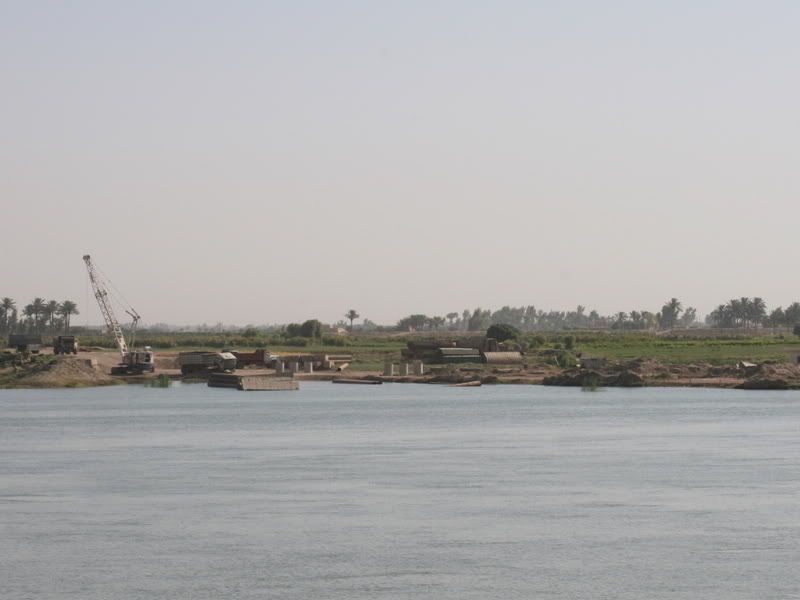
EOD tech turned to me and said "This doesn't look like Iraq at all... It's more like something back in Ohio." Indeed, the scene along the river made me forget for a moment that I was in the desert. Tall trees grew along the road, and dense green undergrowth lined the elevated roadbed. The rain had started and was growing heavier- the wind was beginning to whip the drops sideways. The monsoon hit just as the lead truck found the second
IED. They called up a tripwire stretched across the road, and I turned to ask the
EOD tech which war, exactly, we were fighting?
IED #3 blew up underneath one of the trucks, marking the
beginning of the first time that day all hell would break loose. The driver was
ok, but we now had a truck that needed recovered, on a road barely wide enough to
accommodate one vehicle. We moved most of the convoy off onto a side road, and brought up the wrecker. Two
Bradleys moved up to the rear of our patrol, and veered off into the fields to bypass both us and the blast hole. They came back to the main road just a few hundred meters north of us, and the trail Bradley promptly scored a near miss from another
IED.
EOD started getting calls from the dismount Marine infantry moving up on our rear, and the techs began moving from site to site responding to requests. They reduced another
IED in a controlled detonation, and then moved off to examine
IED-making material that another group found. Just to our rear, a Marine stepped on a booby trap set to target dismount patrols.
EOD moved off once again to clear the site, and the Marine unit began setting up a
MEDIVAC site for the wounded in the field adjacent to us. (Side note: We checked today, and all those guys are
ok) After three hours, four
IEDs, and one vehicle recovery, we were on our way again.
The blast holes from the Bradley and our vehicle effectively blocked the road to our
forward, so we had no choice but to follow the field route the
Bradleys had taken initially. I was the closest to the side road in the Cougar, so I lead out towards the bypass. Iraqi farms typically use flood irrigation, so the fields are lined with ditches. The first such ditch was no problem- I got around it with some maneuvering. The second was a deep double ditch, which I took at a slight cut at
EOD's direction. The truck bottomed out as it hit the second ditch, and slid back into the hole. Stuck. Behind me, the
RG was in the process of winching out of the first ditch. Great. Another hour, a lot of digging, and some help from a Bradley later, we were moving again.
Once back on the road, we got another call from the infantry. The had found more
IEDs on the section of road we were unable to clear. The BUFFALO and
EOD went back to reduce them. With the
IEDs taken care of, we moved to confront our next problems- we had been on mission for a solid twelve hours, and our Humvee security detail was running low on fuel. To add to the matter,
intel reports were coming in warning us to expect strong insurgent resistance to our north. It took nearly another hour to refuel the
Humvees from the
Bradleys, and we pressed forward yet again. The infantry had moved slightly ahead of us, and as we caught up, we watched them digging caches of weapons and munitions out of the riverbank. A Marine sapper tossed a demolition charge into a small hole, and the patrol quickly moved off. We followed, and a few minutes later there was a boom and puff of smoke behind us. I though nothing of it until the next boom threw up a waterspout out in the river, and Marines starting scrambling up the embankment to the other side of the road. Incoming mortar fire sucks, especially when the bad guys are on the far bank 500 meters away. More rounds began to explode on the bank and in the grass; the trucks in front of us caught the exhaust from the mortar tube and began to pour machine-gun fire across the river. Somewhere behind us,
Bradleys opened up with the
whoomp-
whoomp-
whoomp of 25mm chain gun fire. Bullets flew both ways across the water, glinting and sparkling when shots dipped too low and caught the ripples, and abruptly ceased coming from the far side. The Marine landowner on the far side called up and asked us to mark the site with tracer fire for their troops moving in. We did so, and moved out, past the groups of flex-cuffed captives moving south into the gathering night.
By the time dusk fell, we had covered less than one third of the route- the Marines wanted to do the rest, but didn't want to move dismounts without us on the roads for clearance and heavy gun support. Neither we nor the Marines could go much longer without some rest, and the Marines were loath to sweep the riverbank at night. After some discussion among the respective leadership, the Marines settled on a spot in which to set up a firm point and spend the night. It was 1930- we had been on the move for 17 hours.
(Check back tomorrow for Part II)
 Tribal fighters man a checkpoint near the Euphrates


 Investigating an
  Evening shade on the roof of a COP
 Little friends
 A gunner preps his battle bag


 The sun rises over a peaceful Euphrates, near